
Hover to zoom · click to enlarge
| Composition | Cinnarizine & Domperidone Tablets. |
|---|---|
| Packing | 10*10ALU |
| SHELF LIFE | 24 MONTHS |
| HSN CODE | 3004 |
| Category | Tablets |
| Supply | Wholesale & Export |
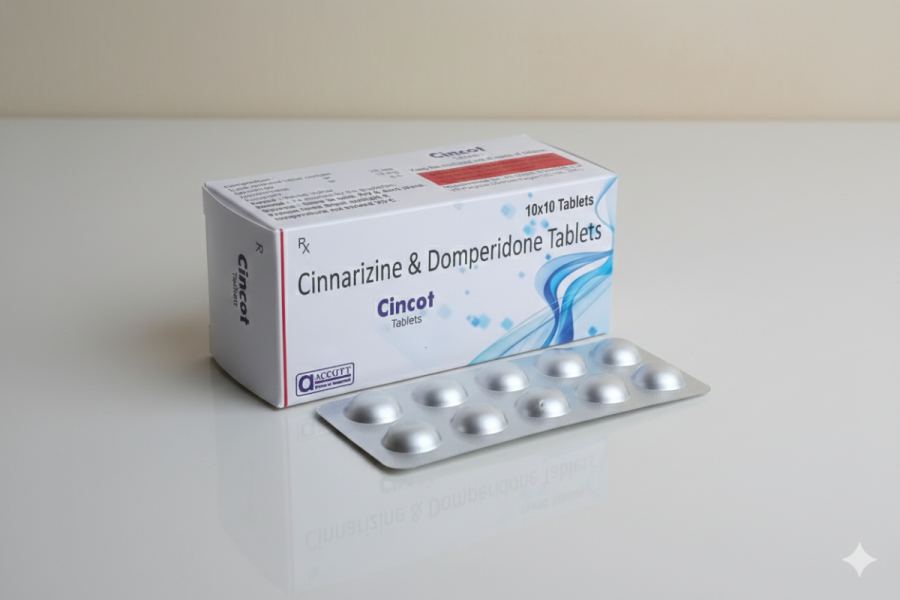
The photograph shows Cincot Tablets from Accott Healthcare. The front clearly identifies the combination as Cinnarizine + Domperidone.
* Important: Accott's online listing for Cincot is internally inconsistent: its product title/description states Cinnarizine 20 mg + Domperidone 15 mg, while another field on the same listing says Domperidone 10 mg. (Tradeindia) Therefore, I would verify the exact domperidone strength from the blister/side panel before relying on the 15-mg figure.
Drug class: Antihistamine with antivertigo/vestibular suppressant properties.
Cinnarizine reduces excessive stimulation of the vestibular system and has calcium-channel-blocking properties. It is used particularly for:
Vertigo/dizziness
Motion sickness
Nausea associated with vestibular disorders
Inner-ear disorders such as Ménière-type symptoms
It can reduce abnormal signals arising from the inner ear that contribute to dizziness, nausea and imbalance.
Common adverse effects:
Drowsiness
Dry mouth
Stomach discomfort
Weight gain with prolonged use in some patients
Long-term use requires medical supervision, particularly in older adults, because extrapyramidal/parkinsonian symptoms have occasionally been associated with cinnarizine.
Drug class: Peripheral dopamine-D₂ receptor antagonist; antiemetic/prokinetic.
Domperidone primarily acts outside the brain and:
Reduces nausea and vomiting
Promotes upper gastrointestinal motility
Helps improve gastric emptying
In this combination, domperidone complements cinnarizine by helping control the nausea/vomiting that can accompany vertigo.
Domperidone can increase the risk of QT prolongation and serious cardiac arrhythmias, particularly at higher doses or in people with underlying heart disease, electrolyte abnormalities, or when combined with certain interacting medicines. Therefore, it should be used at the lowest effective dose for the shortest appropriate duration.
The combination targets two components of vestibular illness:
Cinnarizine → reduces vestibular dizziness/vertigo
Domperidone → reduces nausea and vomiting
Therefore, Cincot may be prescribed for vertigo associated with nausea/vomiting, motion-related symptoms, and selected inner-ear/vestibular disorders. Accott's product description specifically describes it for vertigo, nausea and vomiting associated with inner-ear disorders. (Tradeindia)
May cause sleepiness/drowsiness; avoid driving until you know your response.
Avoid alcohol because it can increase sedation.
Tell your doctor about heart disease, abnormal heartbeat, fainting episodes, or electrolyte problems.
Domperidone has important interactions with some antibiotics, antifungals and other QT-prolonging medicines.
Caution is required in significant liver disease.
Do not self-increase the dose.
The photograph does not provide a sufficiently readable list of the inactive ingredients, so I would not invent them. They are generally listed as excipients q.s. on pharmaceutical packaging.
In summary:
Cincot = Cinnarizine 20 mg + Domperidone (manufacturer listing says 15 mg, but another field says 10 mg) per tablet. Because of this discrepancy, please send a clear photo of the back of the blister/box if you want me to confirm the exact strength with certainty. (Tradeindia)