Hover to zoom · click to enlarge
| Composition | Diclofenac Sodium & Paracetamol Tablets IP. |
|---|---|
| Packing | 20*10 BLISTER |
| SHELF LIFE | 24 MONTHS |
| HSN CODE | 3004 |
| Category | Tablets |
| Supply | Wholesale & Export |
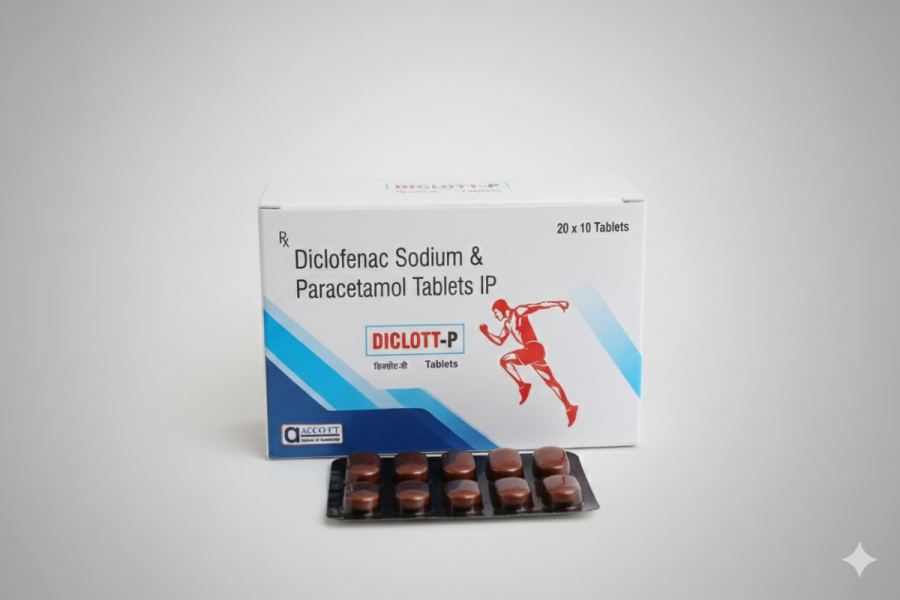
The image shows DICLOTT-P Tablets from Accott Healthcare. The carton states:
Diclofenac Sodium & Paracetamol Tablets IP
The exact marketed composition for Diclott-P is:
Current medicine listings identify Diclott-P specifically as diclofenac 50 mg + paracetamol 325 mg, marketed by Accott Healthcare. (1mg)
Your carton says “Diclofenac Sodium”, whereas some online listings simply state “Diclofenac 50 mg.” The strength being marketed for Diclott-P is 50 mg diclofenac per tablet. (1mg)
1. Diclofenac — 50 mgDiclofenac is a non-steroidal anti-inflammatory drug (NSAID).
Its principal action is inhibition of cyclooxygenase (COX) enzymes, reducing production of prostaglandins involved in pain and inflammation.
Diclofenac → ↓ COX activity → ↓ prostaglandins →
↓ pain
↓ inflammation
↓ swelling
some reduction in fever
This is the component primarily responsible for the anti-inflammatory effect.
It is commonly used for painful inflammatory conditions such as musculoskeletal pain, arthritis, dental pain and other acute painful conditions. Diclott-P listings specifically describe use for conditions including osteoarthritis, rheumatoid arthritis, ankylosing spondylitis, muscle pain, back pain and toothache. (1mg)
2. Paracetamol — 325 mgParacetamol, also called acetaminophen, is an analgesic and antipyretic.
Its major clinical effects are:
pain relief
fever reduction
It has much less peripheral anti-inflammatory activity than diclofenac.
Therefore, the two ingredients complement one another:
Diclofenac → primarily pain + inflammation
Paracetamol → primarily pain + fever
The combination can provide greater analgesic coverage than either component alone in appropriate situations. (1mg)
3. Why combine 50 mg diclofenac with 325 mg paracetamol?The combination is designed for pain where inflammation is also present.
For example:
Diclofenac reduces inflammatory mediators while paracetamol provides additional analgesia.
Both drugs contribute to pain control, while diclofenac also addresses inflammatory components.
Diclofenac reduces inflammation and pain; paracetamol adds analgesic effect.
The combination can provide analgesic and anti-inflammatory action.
4. What are excipients?The active ingredients account for:
50 mg + 325 mg = 375 mg of stated active ingredients per tablet.
The finished tablet weighs more than this because it contains excipients.
Excipients may perform functions such as:
providing bulk
binding powder into a tablet
helping the tablet disintegrate
preventing sticking during manufacture
improving stability
providing coating/appearance
The front of your photograph does not provide the individual excipient names or quantities, so those should not be guessed.
5. Is DICLOTT-P the same as DICLOTT-SP?No.
This is particularly important because you previously showed DICLOTT-SP.
Diclofenac + Paracetamol
Diclofenac + Paracetamol + Serratiopeptidase
So:
Do not assume they are interchangeable simply because their names are similar.
6. Main side effectsBecause DICLOTT-P contains an NSAID, diclofenac-related adverse effects are particularly important.
Possible effects include:
nausea
vomiting
stomach pain
indigestion
acidity/heartburn
diarrhea
constipation
dizziness
headache
More serious but less common problems include:
stomach/intestinal ulcer or bleeding
kidney impairment
fluid retention
increased blood pressure
cardiovascular complications
liver injury
serious allergic reactions
Diclofenac can irritate the stomach and increase the risk of gastrointestinal bleeding.
Risk is greater in people with:
previous stomach ulcer
previous GI bleeding
older age
prolonged NSAID use
high NSAID doses
corticosteroid use
anticoagulant/antiplatelet use
certain antidepressants
significant alcohol consumption
Taking it with food may reduce stomach upset, although food does not eliminate the risk of ulcer or bleeding.
8. Kidney and heart precautionsNSAIDs such as diclofenac can affect kidney blood flow.
Extra caution is required in people with:
chronic kidney disease
dehydration
heart failure
uncontrolled hypertension
significant cardiovascular disease
Diclofenac also has recognized cardiovascular risks, particularly with higher doses and prolonged treatment.
Therefore, it is generally preferable to use the lowest effective dose for the shortest appropriate duration when an NSAID is required.
9. Paracetamol safetyThe 325 mg paracetamol component is important when considering other medicines.
Do not accidentally take additional paracetamol-containing products without accounting for the total amount.
Paracetamol overdose can cause severe liver injury.
This is particularly important with combination cold/flu preparations, many of which also contain paracetamol.
10. Medicines that should not be casually combinedDo not routinely combine DICLOTT-P with another NSAID such as:
ibuprofen
naproxen
diclofenac-containing products
aspirin when being used as another painkiller
Doing so can increase adverse effects, particularly gastrointestinal and kidney toxicity.
Also inform your doctor/pharmacist if taking:
warfarin or other anticoagulants
aspirin
clopidogrel
corticosteroids
blood-pressure medicines
diuretics
medicines affecting kidney function
Diclofenac and other NSAIDs require particular caution during pregnancy.
NSAIDs should generally be avoided in the third trimester, because of important fetal and maternal risks.
If pregnant, trying to conceive, or breastfeeding, DICLOTT-P should be used only on medical advice.
12. Is DICLOTT-P an antibiotic?No.
It contains no antibiotic.
It treats pain/inflammation, not the underlying bacterial cause of an infection.
For example, if dental pain is caused by a dental abscess, this medicine may temporarily reduce pain but does not eradicate the infection.
13. Is it a steroid?No.
Diclofenac is an NSAID, not a corticosteroid.
Diclofenac — 50 mg
Paracetamol — 325 mg
Excipients — q.s.
Total stated active-drug content = 375 mg/tablet.
The product is therefore a two-drug analgesic combination, with diclofenac providing the principal anti-inflammatory action and paracetamol providing additional pain relief and antipyretic action. The 50 mg + 325 mg composition is independently listed for Diclott-P by current medicine references. (1mg)
If you want the exact formulation in pharmaceutical-manufacturing detail (salt equivalence, excipients, tablet coating, mechanism, pharmacokinetics, dose, contraindications, interactions, and comparison with DICLOTT-SP), I can lay that out as a full product monograph.