
Hover to zoom · click to enlarge
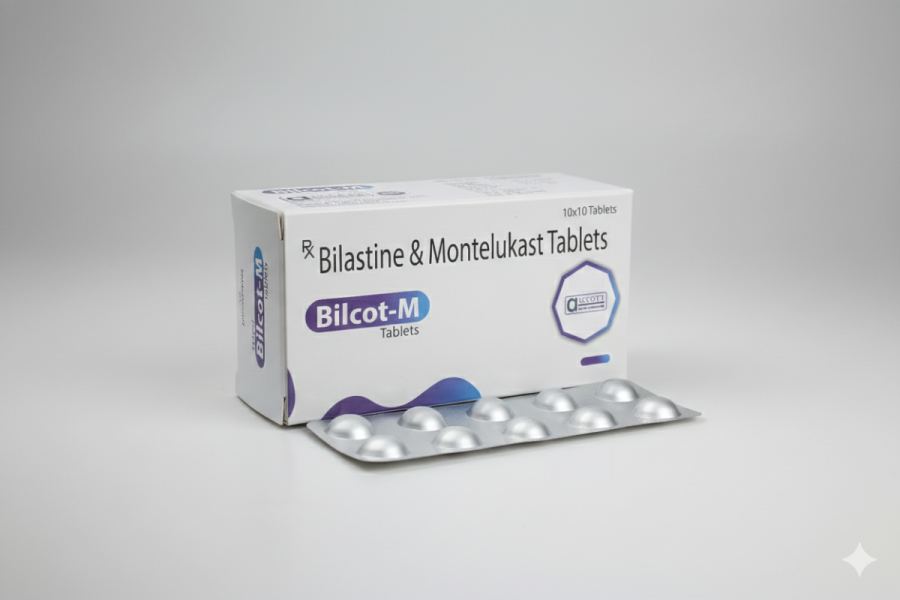
| Composition | Bilastine & Montelukast Tablets. |
|---|---|
| Packing | 10*10ALU |
| SHELF LIFE | 24 MONTHS |
| HSN CODE | 3004 |
| Category | Tablets |
| Supply | Wholesale & Export |
Bilcot-M Tablets, labeled “Bilastine & Montelukast Tablets.” It is a prescription anti-allergy medicine, mainly used for allergic rhinitis and related allergy symptoms.
The usual tablet strength for this combination is Bilastine 20 mg + Montelukast 10 mg. The Indian Pharmacopoeia Commission lists 20 mg/10 mg as the usual strength for bilastine + montelukast tablets. (Indian Pharmacopoeia Commission)
So, in simple terms:
Bilastine → controls sneezing, itching, runny nose and watery eyes
Montelukast → reduces leukotriene-mediated inflammation and nasal/airway symptoms
1. Bilastine 20 mgBilastine is a modern, relatively non-sedating H1 antihistamine.
When you encounter an allergen—such as pollen, dust mites or animal dander—your body can release histamine.
Histamine contributes to:
Sneezing
Runny nose
Nasal itching
Eye itching
Watery eyes
Skin itching
Hives/urticaria
Bilastine blocks H1 histamine receptors, thereby reducing these symptoms.
Allergic rhinitis
Seasonal allergies
Perennial/year-round allergic rhinitis
Urticaria (hives)
Allergy-related itching
It generally causes less sedation than older antihistamines, although drowsiness or dizziness can still occur in some people.
2. Montelukast 10 mgMontelukast is not an antihistamine.
It belongs to a different class called a leukotriene receptor antagonist (LTRA).
When the body reacts to allergens, it can produce leukotrienes. These chemical mediators can contribute to:
Nasal inflammation
Nasal congestion
Mucus production
Airway narrowing
Airway inflammation
Montelukast blocks the CysLT1 leukotriene receptor, reducing the effects of leukotrienes.
Thus, it complements bilastine by addressing a different pathway of allergic inflammation.
Why combine bilastine + montelukast?The two medicines work through different mechanisms:
Allergen → histamine → sneezing/itching/runny nose
→ Bilastine blocks histamine
and
Allergen → leukotrienes → inflammation/congestion/airway effects
→ Montelukast blocks leukotriene receptors
Therefore, the combination can provide broader control of allergy symptoms than an antihistamine alone in selected patients.
The combination is commonly used for allergic rhinitis, particularly when symptoms are troublesome or inadequately controlled with an antihistamine alone. (Abbott)
What symptoms can Bilcot-M help?It can help relieve:
🤧 Repeated sneezing
👃 Runny nose
👃 Nasal itching
👃 Nasal congestion/blockage
👁️ Watery eyes
👁️ Itchy eyes
Skin itching associated with allergic conditions
It may be particularly useful when nasal congestion is a prominent component of the allergy.
Important: It is NOT an antibioticBilcot-M does not treat bacterial infections.
So it is completely different from the Cefott products you showed earlier.
Bilastine + Montelukast
→ Allergy
Cefixime
→ Bacterial infection
Cefixime + Ofloxacin
→ Bacterial infection
For the usual 20 mg bilastine + 10 mg montelukast combination, product information commonly specifies one tablet once daily when prescribed for adults. (Abbott)
Bilastine absorption can be significantly reduced by food and fruit juice.
It is generally taken:
1 hour before food OR 2 hours after food/fruit juice.
In particular, fruit juices such as grapefruit, orange or apple juice can reduce bilastine exposure. (Apollo Pharmacy)
So, for example, if you take the tablet at 7:00 AM, wait until approximately 8:00 AM before breakfast.
Or you can take it 2 hours after eating.
Follow the exact instructions given by your prescribing doctor because formulations and prescribing instructions can vary.
Common side effectsPossible adverse effects include:
Headache
Drowsiness
Dizziness
Fatigue
Bilastine is generally less sedating than older antihistamines, but individual responses differ.
Headache
Abdominal discomfort
Nausea
Diarrhea
Fatigue
The most important safety issue with montelukast is neuropsychiatric effects.
⚠️ Important montelukast warningMontelukast has been associated with neuropsychiatric adverse effects, including:
Abnormal dreams/nightmares
Sleep disturbance
Irritability
Anxiety
Agitation
Mood changes
Depression
Aggressive behavior
Rarely, suicidal thoughts or behavior
If significant mood, behavior or sleep changes occur after starting montelukast, contact the prescribing doctor promptly.
If there are suicidal thoughts or immediate concerns about safety, seek urgent medical help.
Because of these risks, montelukast should not automatically be considered the first choice for uncomplicated allergic rhinitis when other effective treatments are appropriate.
Who should tell the doctor before taking it?Tell your doctor if you have:
A history of depression or other psychiatric illness
Previous suicidal thoughts/behavior
Significant liver disease
Kidney disease
Pregnancy or breastfeeding
Other medicines for allergies/asthma
Also tell the doctor if you're already taking another antihistamine or another montelukast-containing medicine.
Bilcot-M and asthmaMontelukast is also used in the management of asthma, but there is an important distinction:
Bilcot-M is not a rescue medicine for an acute asthma attack.
If someone suddenly develops severe wheezing, chest tightness or difficulty breathing, montelukast should not be relied upon as an immediate-relief medication. An appropriately prescribed rescue inhaler should be used according to the person's asthma action plan, and emergency care sought when necessary.
Bilcot-M vs ordinary antihistamineFor example:
Bilastine alone
→ primarily blocks histamine.
Bilastine + montelukast
→ blocks histamine and leukotriene pathways.
Therefore, the combination may be selected when allergy symptoms—particularly nasal congestion/inflammatory symptoms—are not adequately controlled with an antihistamine alone.
You've shown several medicines, and they serve very different purposes:
One caution: these shouldn't all be assumed to belong to one treatment regimen. In particular, the Cefott products contain overlapping antibiotics, so Cefott-100, Cefott-200, Cefott-200 LB and Cefott-O should not be combined or substituted without the prescriber's instructions.