
Hover to zoom · click to enlarge
| Composition | Deflazacort Tablets. |
|---|---|
| Packing | 10*10ALU |
| SHELF LIFE | 24 MONTHS |
| HSN CODE | 3004 |
| Category | Tablets |
| Supply | Wholesale & Export |
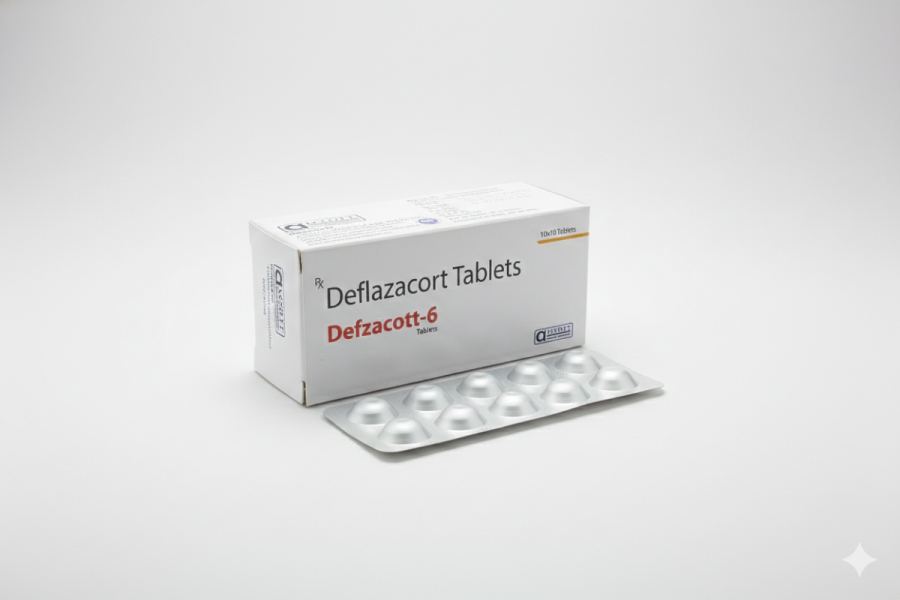
The photograph shows Defzacott-6 Tablets from Accott Healthcare. The front of the carton clearly states:
Deflazacort Tablets
Defzacott-6
This is a corticosteroid (glucocorticoid) medicine. Unlike the DICLOTT products you showed earlier, this is not an ordinary painkiller.
Thus:
Each Defzacott-6 tablet contains Deflazacort 6 mg.
The “-6” in the brand name corresponds to the 6 mg strength.
1. What is Deflazacort?Deflazacort is a synthetic glucocorticoid corticosteroid.
It belongs to the same broad therapeutic family as drugs such as:
prednisolone
prednisone
methylprednisolone
dexamethasone
It is not an anabolic steroid.
Its principal effects are:
↓ inflammation, swelling and inflammatory symptoms
↓ excessive or inappropriate immune-system activity
2. How does Deflazacort work?Deflazacort enters cells and interacts with the glucocorticoid receptor.
The drug-receptor complex influences gene transcription and alters the production of numerous inflammatory mediators.
In simplified form:
Deflazacort → glucocorticoid receptor → altered gene transcription → ↓ inflammatory mediators → ↓ inflammation
It can reduce inflammatory activity involving:
cytokines
inflammatory enzymes
immune-cell activity
vascular permeability
inflammatory signaling molecules
Therefore, its effect is much broader than that of a simple analgesic.
3. What does 6 mg mean?Deflazacort 6 mg means that each tablet contains 6 mg of the active corticosteroid.
However, 6 mg deflazacort should not be considered equivalent to 6 mg prednisolone.
Deflazacort and prednisolone have different potencies.
As a commonly used approximate clinical comparison:
6 mg deflazacort ≈ 5 mg prednisolone
This is an approximation used for corticosteroid equivalence; the exact clinical conversion depends on the indication, duration and patient.
Do not independently substitute one steroid for another based only on this conversion.
4. What is Defzacott-6 used for?Deflazacort can be prescribed for conditions in which corticosteroid anti-inflammatory or immunosuppressive activity is required.
Depending on the clinical situation, it may be used in conditions involving:
severe allergic/inflammatory reactions
autoimmune diseases
rheumatological diseases
inflammatory joint disorders
certain skin diseases
inflammatory respiratory conditions
some neurological/inflammatory conditions
selected muscular disorders
It has also been used in Duchenne muscular dystrophy (DMD) in appropriate patients.
The appropriate dose varies enormously depending on the disease. A 6-mg tablet does not mean that every condition is treated with one tablet daily.
5. Is it a painkiller?Deflazacort is not primarily an analgesic.
It can reduce pain indirectly when pain is caused by inflammation.
For example:
Inflammation → swelling/tissue irritation → pain
Deflazacort:
↓ inflammation → ↓ inflammatory pain
But it does not work like:
paracetamol
diclofenac
ibuprofen
You previously showed:
Diclofenac + Paracetamol
Diclofenac + Paracetamol + Serratiopeptidase
Diclofenac + Paracetamol + Chlorzoxazone
These are primarily pain/inflammation-oriented combinations.
Deflazacort 6 mg
This is a systemic corticosteroid.
It is therefore a substantially different medicine and should not be substituted for diclofenac or routinely combined with it without medical direction.
7. Side effectsThe adverse effects of corticosteroids depend heavily on:
dose
duration
frequency
underlying disease
patient's age
other medicines
increased appetite
indigestion
mood changes
insomnia
increased blood glucose
increased blood pressure
fluid retention
stomach discomfort
weight gain
characteristic changes in body-fat distribution
osteoporosis
muscle weakness
skin thinning
easy bruising
impaired wound healing
cataracts
glaucoma
increased susceptibility to infections
adrenal suppression
menstrual changes
metabolic disturbances
Not everyone develops these effects, and risk is strongly related to exposure.
8. Blood sugarDeflazacort can increase blood glucose.
People with:
diabetes
prediabetes
obesity
a history of steroid-induced hyperglycemia
may require particular monitoring.
A person taking corticosteroids may notice increased thirst or urination if glucose becomes significantly elevated.
9. Infection riskBecause corticosteroids suppress aspects of immune function, they can:
increase susceptibility to infections or make existing infections harder to recognize.
Steroids can also suppress fever and other inflammatory signs, potentially masking infection.
Therefore, unexplained fever, persistent cough, worsening wound redness, or other signs of infection should be taken seriously.
10. Why should it not be stopped suddenly?This is one of the most important points with systemic corticosteroids.
With prolonged or sufficiently intensive corticosteroid treatment, the body's own adrenal glands can reduce their natural cortisol production.
The pathway is approximately:
Steroid treatment → suppression of HPA axis → ↓ endogenous cortisol production
If the steroid is suddenly stopped after significant exposure, the body may not immediately be able to produce enough cortisol.
This can result in adrenal insufficiency.
Therefore:
Do not abruptly discontinue long-term or high-dose deflazacort without medical advice.
A doctor may gradually taper the dose when appropriate.
A short, low-dose course may not always require tapering, but this depends on the actual regimen.
11. Stomach considerationsDeflazacort itself is not identical to an NSAID such as diclofenac, but corticosteroids can contribute to gastrointestinal risk, particularly when combined with NSAIDs.
This is especially relevant to your previous medicines:
Deflazacort + diclofenac
may increase gastrointestinal complications in susceptible patients.
Therefore, this combination should be used only when medically appropriate.
12. Vaccination considerationsBecause corticosteroids can suppress immune responses, vaccination planning may need consideration when a person is receiving high-dose or prolonged corticosteroid therapy.
The effect depends on the dose and duration.
A healthcare professional should be informed about ongoing steroid treatment before certain vaccinations.
13. ExcipientsThe tablet also contains inactive substances, collectively described as excipients q.s.
These are used for:
tablet formation
binding
hardness
disintegration
lubrication
stability
appearance/coating
The photograph does not show a sufficiently readable ingredient panel to identify the exact excipients and their quantities, so those should not be guessed.
14. Composition summaryActive ingredient:
Inactive ingredients:
Excipients — q.s.
Systemic glucocorticoid corticosteroid
Anti-inflammatory + immunosuppressive
Increased blood glucose, infection risk, blood-pressure/fluid effects, mood/sleep changes, and adrenal suppression with prolonged use.
Do not start, increase, or suddenly stop deflazacort without the prescribing clinician's advice, particularly if it has been taken for an extended period.
If you provide a clear photograph of the back/side panel of the Defzacott-6 box, I can also extract the exact printed composition, excipients, manufacturer details, storage instructions, and pack information line by line.