
Hover to zoom · click to enlarge
| Composition | Pantoprazole Sodium + Domperidone 10 mg |
|---|---|
| Packing | 10*10ALU |
| SHELF LIFE | 24 MONTHS |
| HSN CODE | 3004 |
| Category | Tablets |
| Supply | Wholesale & Export |
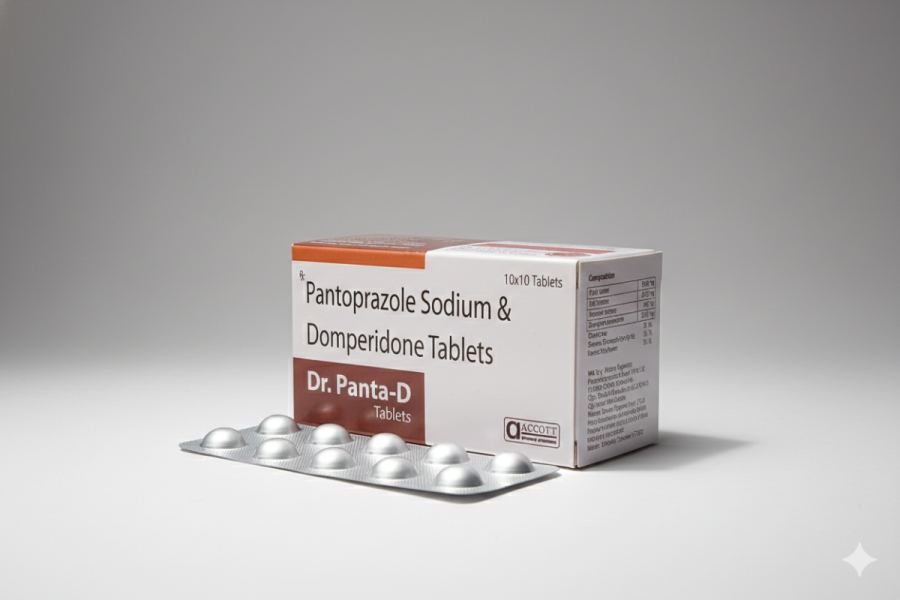
The photograph shows Dr. Panta-D Tablets from Accott Healthcare. The front of the carton states “Pantoprazole Sodium & Domperidone Tablets.” The side panel also shows the composition and excipient quantities, although the photograph is not sharp enough for me to read every digit with certainty.
The important point is that this is a combination medicine containing a proton-pump inhibitor (pantoprazole) and a prokinetic/antiemetic (domperidone).
The formulation is:
For the Panta-D tablet formulation, published Indian medicine listings identify the combination as Pantoprazole 40 mg + Domperidone 10 mg. (Scribd)
So, the clinically relevant composition is:
Pantoprazole — 40 mg
Domperidone — 10 mg
This should not be confused with Panta-D SR/DSR formulations, which commonly contain pantoprazole 40 mg + domperidone sustained-release 30 mg. (Apollo Pharmacy)
2. Pantoprazole sodium — detailedPantoprazole is a proton-pump inhibitor (PPI).
It is supplied in the tablet as pantoprazole sodium, which is the salt form used for pharmaceutical formulation. The stated therapeutic strength is generally expressed as pantoprazole equivalent.
The stomach contains parietal cells, which produce hydrochloric acid (HCl).
The final step in gastric-acid secretion is performed by the:
H⁺/K⁺-ATPase — gastric proton pump
Pantoprazole inhibits this enzyme.
Pantoprazole → proton-pump inhibition → ↓ gastric HCl → ↓ acidity
This helps reduce irritation from acid and allows acid-related inflammation/ulcers to heal.
Pantoprazole is commonly used for:
GERD / acid reflux
heartburn
reflux oesophagitis
acid-related dyspepsia
peptic ulcers
acid-associated gastric irritation
as part of some H. pylori eradication regimens
Domperidone is primarily a peripheral dopamine D₂-receptor antagonist with prokinetic and antiemetic effects.
It is quite different from pantoprazole.
Pantoprazole mainly addresses excess gastric acid, whereas domperidone helps with gastric motility and nausea/vomiting.
Domperidone enhances upper gastrointestinal motility and can help improve gastric emptying.
Simplified:
Domperidone → ↑ upper-GI motility → faster gastric emptying → ↓ gastric fullness/reflux tendency
It also has an antiemetic effect by blocking peripheral dopamine receptors involved in nausea and vomiting.
4. Why are the two drugs combined?The combination is intended for patients in whom acid reflux/GERD or dyspepsia occurs together with symptoms such as nausea, vomiting, bloating or delayed gastric emptying.
Their actions complement one another:
Pantoprazole
→ reduces acid production
+
Domperidone
→ improves upper-GI motility and helps nausea
=
Reduction of acid-related symptoms plus improvement of associated motility/nausea symptoms.
Indian drug references list pantoprazole + domperidone combinations for conditions such as GERD/acid reflux and peptic-ulcer disease. (1mg)
5. Excipients shown on your boxThe right-hand side of your photograph has a “Composition” table followed by additional excipients.
I can make out that the label lists several inactive ingredients, but because the original photograph is only about a few dozen pixels wide in that area, I cannot responsibly claim exact quantities for every excipient.
The visible label appears to include entries resembling:
Pantoprazole sodium
HPMC/Hypromellose or a related coating/binding material
Sodium-based excipient
Domperidone
D&C/colouring material
Croscarmellose sodium
another tablet excipient
The exact numbers are too blurred to establish reliably.
I would not recommend using a guessed excipient list, especially if you're asking because of an allergy or intolerance.
If you provide a close-up, high-resolution photograph of just the composition panel, I can transcribe it line-by-line.
6. Why pantoprazole tablets may have a special coatingPantoprazole is acid-sensitive. The formulation therefore commonly uses a gastro-resistant/enteric protective system.
The principle is:
Stomach → coating protects drug
Intestine → coating dissolves → drug is released
This is why pantoprazole gastro-resistant tablets are generally intended to be swallowed whole rather than crushed or chewed.
7. How the medicine is generally takenFor conventional pantoprazole/domperidone tablets, the prescribed dose is commonly taken before food, often in the morning.
The exact regimen depends on the product and the patient's condition.
Do not assume that a 40/10 tablet and a 40/30 SR capsule have the same dosing instructions.
For example:
Panta-D: pantoprazole 40 mg + domperidone 10 mg
Panta-D SR/DSR: commonly pantoprazole 40 mg + domperidone SR 30 mg
These are different formulations. (Scribd)
8. Important side effectsPossible effects include:
headache
nausea
abdominal discomfort
diarrhea
constipation
flatulence
dizziness
Possible effects include:
dry mouth
abdominal cramps/discomfort
headache
dizziness
diarrhea
changes in prolactin-related symptoms
More importantly, domperidone can affect cardiac electrical conduction and may prolong the QT interval, potentially increasing the risk of serious heart rhythm problems in susceptible patients.
Therefore, it should be used cautiously in people with:
known QT prolongation
significant heart disease
significant electrolyte abnormalities
certain rhythm disorders
significant liver impairment
medicines that themselves prolong QT or strongly inhibit CYP3A4
This is one reason domperidone should not simply be taken repeatedly for ordinary acidity without medical advice.
9. Important distinction from ordinary antacidsDr. Panta-D is not simply an antacid.
An antacid such as calcium carbonate or magnesium hydroxide chemically neutralizes acid already present in the stomach.
Pantoprazole works differently:
Pantoprazole → suppresses the stomach's acid production.
Domperidone is different again:
Domperidone → acts on GI motility and nausea pathways.
So this is a PPI + prokinetic/antiemetic combination.
10. Simple mechanism diagram DR. PANTA-D
│
┌───────────┴───────────┐
│ │
PANTOPRAZOLE DOMPERIDONE
40 mg 10 mg
│ │
↓ ↓
Proton-pump inhibition D₂ receptor blockade
│ │
↓ ↓
↓ Gastric acid ↑ Upper-GI motility
│
↓
Better gastric emptying
│
↓
↓ Nausea / fullness
│ │
└───────────┬───────────┘
↓
Relief of acid-reflux/
dyspeptic symptomsDr. Panta-D = Pantoprazole 40 mg + Domperidone 10 mg in the conventional Panta-D tablet formulation. The two components have different purposes: pantoprazole suppresses gastric acid, while domperidone improves upper-GI motility and helps nausea/vomiting. Published Indian listings distinguish this 40/10-mg tablet from the 40/30-mg sustained-release Panta-D SR/DSR products. (Scribd)
If you upload a sharp close-up of the right-side “Composition” panel, I can also give you the exact excipient names and mg quantities printed by Accott, rather than estimating them from this photograph.