
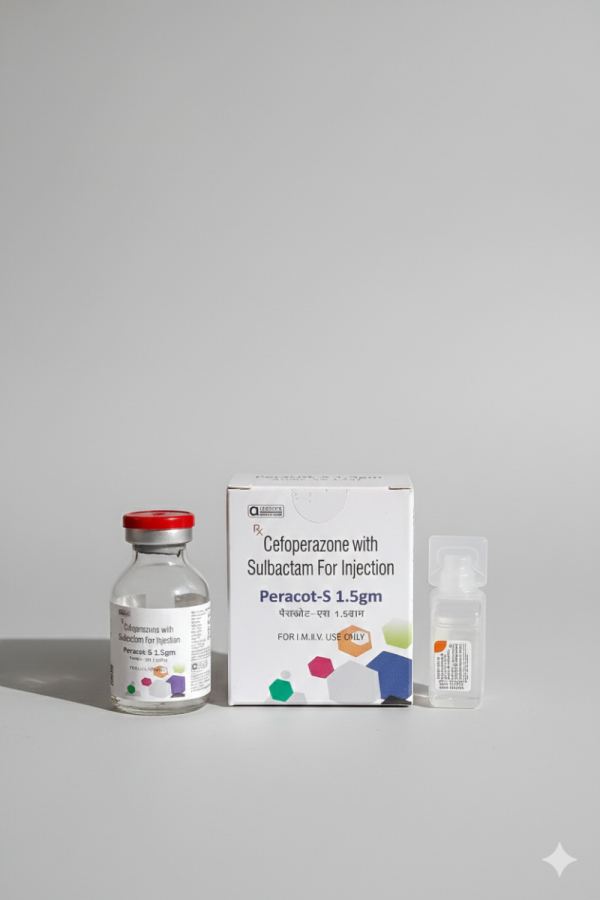
Hover to zoom · click to enlarge
| Composition | Cefoperazone + Sulbactam Peracot-S 1.5 g injection |
|---|---|
| Packing | 1.5GM |
| SHELF LIFE | 24 MONTHS |
| HSN CODE | 3004 |
| Category | Injections |
| Supply | Wholesale & Export |
Peracot-S 1.5 g Injection
For the commonly used 1:0.5 formulation shown by this type of product:
The exact salt/formulation should be confirmed from the product insert because cefoperazone/sulbactam products can vary in their labeling.
1. What kind of antibiotic is it?This is a β-lactam antibiotic combination.
Cefoperazone is a third-generation cephalosporin antibiotic. It kills susceptible bacteria by interfering with bacterial cell-wall formation.
Sulbactam is a β-lactamase inhibitor. Some bacteria produce β-lactamase enzymes that can destroy β-lactam antibiotics. Sulbactam inhibits certain of these enzymes, helping protect cefoperazone.
In simplified terms:
Sulbactam → blocks certain bacterial resistance enzymes → cefoperazone can work more effectively.
2. What infections can it be used for?Cefoperazone/sulbactam is used for bacterial infections that are susceptible to the combination, particularly infections requiring injectable treatment.
Depending on the clinical situation, it may be used for:
The exact choice should ideally be guided by the suspected organism, infection site and, when available, culture and antibiotic-susceptibility results.
It does not treat fungal infections such as ordinary ringworm.
3. Why is sulbactam added?Think of some bacteria as having a defensive enzyme:
Bacteria → β-lactamase → destroys certain antibiotics
Sulbactam inhibits some of those enzymes:
Sulbactam → inhibits β-lactamase → protects cefoperazone
However, this doesn't overcome every form of antibiotic resistance. That's why culture/sensitivity testing can be important in serious infections.
4. How is it administered?The box specifically says:
“FOR I.M./I.V. USE ONLY.”
That means it can be administered:
depending on the prescribed formulation and clinical situation.
The powder needs to be properly reconstituted with a compatible diluent before administration. The accompanying liquid ampoule visible in your photograph appears to be the diluent.
This should be prepared and administered by a healthcare professional, not self-injected.
5. Important side effectsPossible adverse effects include:
This is particularly important if someone has previously had a serious allergy to:
Symptoms such as facial/throat swelling, difficulty breathing, widespread hives, or severe dizziness require immediate medical attention.
Like other broad-spectrum antibiotics, it can occasionally cause C. difficile-associated diarrhea/colitis. Severe or persistent diarrhea during treatment or after completing the antibiotic should be evaluated.
6. A special point about cefoperazone: bleeding riskCefoperazone has a relatively distinctive precaution among antibiotics: it can occasionally interfere with vitamin-K-dependent clotting, particularly in people who are nutritionally compromised, have liver/biliary problems, malabsorption, or receive prolonged antibiotic therapy.
The official cefoperazone labeling reports hypoprothrombinemia with or without bleeding and recommends monitoring clotting parameters in higher-risk patients. FDA Access Data
This is particularly worth mentioning because you previously showed Trancot (tranexamic acid), which is a medicine used to help control certain types of bleeding.
That does not mean Peracot-S and Trancot should or should not be given together—the reason for the bleeding and the doctor's clinical assessment determine that. But if both were prescribed to the same patient, the medical team should know about any history of abnormal bleeding, liver disease, poor nutrition, or anticoagulant use.
7. Alcohol considerationCefoperazone has also been associated with a disulfiram-like reaction when alcohol is consumed around the time of treatment, including symptoms such as flushing, sweating, headache and rapid heartbeat. The cefoperazone prescribing information advises avoiding alcoholic beverages for a period after administration. FDA Access Data
So it's sensible to avoid alcohol during treatment and for the period advised by the treating clinician/pharmacist.
8. Kidney and liver considerationsThe patient's liver and kidney function can matter when choosing and monitoring antibiotic treatment.
Cefoperazone is substantially eliminated through the biliary/liver route, while sulbactam is more dependent on renal elimination. Patients with significant liver and kidney problems may therefore require closer monitoring and individualized dosing.
The doctor may monitor:
These two injections are both broad-spectrum IV/IM antibiotics, but they are different antibiotics:
| Peracot-S 1.5 g | Pipracot-TZ 4.5 g | |
|---|---|---|
| Main antibiotic | Cefoperazone | Piperacillin |
| Added component | Sulbactam | Tazobactam |
| Class | 3rd-gen cephalosporin + β-lactamase inhibitor | Penicillin-class β-lactam + β-lactamase inhibitor |
| Strength shown | 1.5 g | 4.5 g |
| Route | IM/IV | IV only |
| Main purpose | Serious susceptible bacterial infections | Serious susceptible bacterial infections |
They should not automatically be given together simply because both are antibiotics. Using two broad-spectrum β-lactam antibiotics simultaneously requires a specific clinical reason.
| Medicine | Main purpose |
|---|---|
| Trancot — tranexamic acid | Helps control certain bleeding |
| Redflam — diclofenac | Pain/inflammation |
| Piroxcot — piroxicam | Pain/inflammation |
| Pipracot-TZ 4.5 — piperacillin/tazobactam | Serious bacterial infection |
| Peracot-S 1.5 — cefoperazone/sulbactam | Serious bacterial infection |
The two pain injections (diclofenac and piroxicam) are both NSAIDs, while the last two are both broad-spectrum antibiotics. Therefore, if all five medicines belong to the same patient's treatment chart, the exact prescription and timing matter considerably.
If you upload the prescription/medication chart, I can put all the injections and creams you've shown into one consolidated table, including what each is for, which medicines overlap, and the combinations that warrant particular attention.