
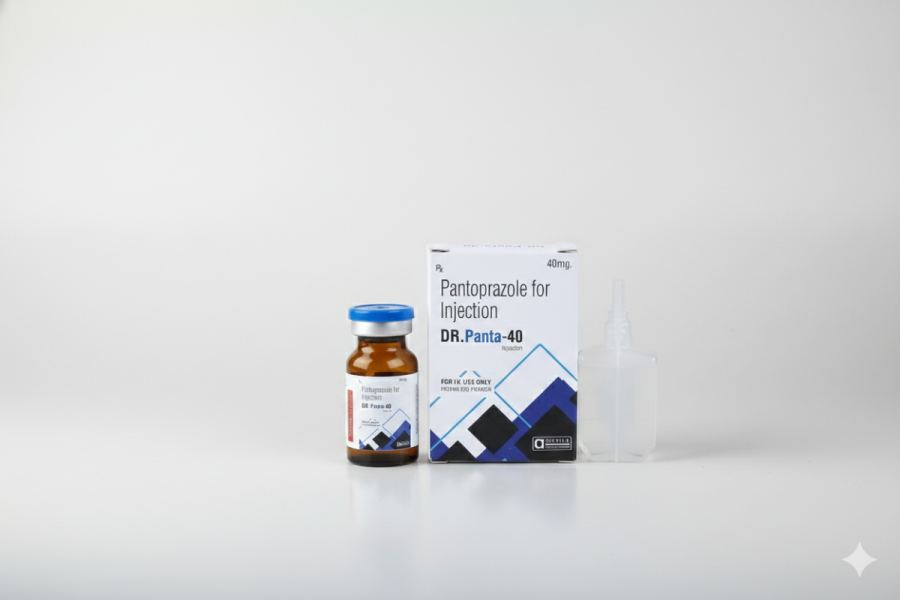
Hover to zoom · click to enlarge
| Composition | Pantoprazole for Injection IP |
|---|---|
| Packing | 10ML |
| SHELF LIFE | 24 MONTHS |
| HSN CODE | 3004 |
| Category | Injections |
| Supply | Wholesale & Export |
DR. PANTA-40 INJ
The second image shows DR. Panta-40, an injectable pantoprazole 40 mg product.
Pantoprazole injection is a proton-pump inhibitor (PPI). It reduces the production of acid by the stomach. Official prescribing information describes 40-mg pantoprazole injection as a preparation for intravenous use. DailyMed
Pantoprazole reduces excessive stomach acid and may be prescribed for conditions such as:
It is not a painkiller and does not directly treat the underlying cause of every type of abdominal pain.
Normally, specialized cells in the stomach produce hydrochloric acid using an enzyme called the H⁺/K⁺-ATPase, commonly called the proton pump.
Pantoprazole blocks this proton pump:
Pantoprazole → inhibits gastric proton pump → less stomach acid → reduced acid exposure
This is why it can help symptoms and healing associated with acid-related disorders.
The vial shown is a powder for injection, rather than a ready-to-inject liquid. Official labeling describes 40 mg pantoprazole as a freeze-dried powder requiring reconstitution/dilution before IV administration. DailyMed
For example, one official formulation specifies reconstitution with 0.9% sodium chloride and administration intravenously. The exact preparation procedure can vary by manufacturer's product, so the instructions supplied with this particular DR. Panta-40 product should be followed by the healthcare professional. DailyMed
It should not be mixed or injected at home.
Pantoprazole can cause, among other effects:
More serious allergic reactions are possible, although uncommon. IV pantoprazole can also cause thrombophlebitis (inflammation of a vein at the injection site). DailyMed
With prolonged PPI treatment, clinicians may also consider issues such as low magnesium, vitamin B12 deficiency, certain intestinal infections, and bone-related effects, depending on duration and individual risk.
The two products you showed are quite different:
So they do not treat the same problem. If these two injections were prescribed together, there may be a specific reason based on the patient's diagnosis.
If you show me the prescription or the back/side of both boxes, I can explain why these two injections may have been prescribed together, the usual timing between them, and what each one is intended to do.