
Hover to zoom · click to enlarge
| Composition | Tranexamic Acid Injection IP |
|---|---|
| Packing | 1*5 |
| SHELF LIFE | 24 MONTHS |
| HSN CODE | 3004 |
| Category | Injections |
| Supply | Wholesale & Export |
TRANCOT INJ
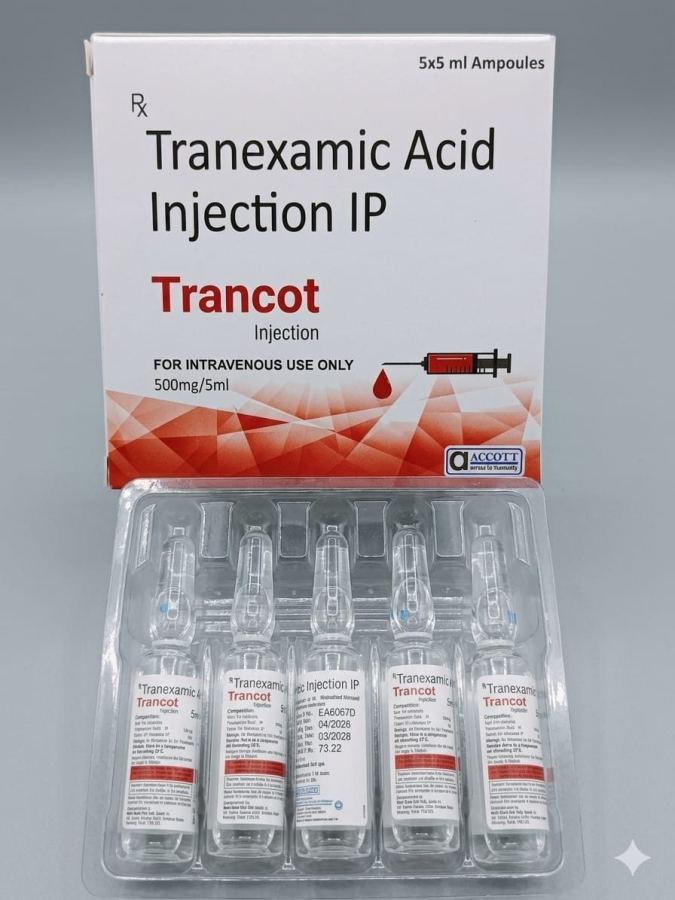
This image shows Trancot Injection, containing tranexamic acid. Unlike the creams you've shown previously, this is a prescription injectable medicine used to reduce or stop bleeding.
The product works as an antifibrinolytic: it helps prevent the body from breaking down blood clots too quickly, thereby helping control bleeding. DailyMed
Tranexamic acid can be used in situations where excessive bleeding needs to be controlled. Depending on the clinical situation and formulation, doctors may use it for things such as:
The exact indication and dose depend heavily on why the person is bleeding, so the 500-mg ampoule should not be self-administered.
A simplified explanation:
Clot forms → body naturally produces plasmin → plasmin breaks down fibrin → clot dissolves
Tranexamic acid inhibits this fibrin breakdown, helping the clot remain in place longer.
So it doesn't directly create a new blood clot in the same way that a clotting-factor medicine does; it primarily prevents premature breakdown of existing clots.
The box specifically says “FOR INTRAVENOUS USE ONLY.”
This is important because accidental administration by the wrong route can cause severe complications. Current prescribing information specifically warns that tranexamic acid injection should not be given neuraxially (into the spinal/epidural space); inadvertent administration can cause seizures and potentially fatal complications. DailyMed
It should therefore be administered only by an appropriately trained healthcare professional.
Tranexamic acid can be associated with thromboembolic events (blood clots in veins or arteries), and it is contraindicated in patients with active intravascular clotting. DailyMed
Doctors also need to consider:
Renal impairment is particularly important because tranexamic acid is substantially cleared through the kidneys and the dose may need to be reduced. DailyMed
Reported effects include:
The packaging shows 5 ampoules × 5 mL.
At 500 mg per 5 mL, each ampoule contains:
500 mg tranexamic acid
Therefore, the entire five-ampoule pack contains:
2,500 mg (2.5 g) total tranexamic acid.
That does not mean all five ampoules should be given. The number of ampoules and administration schedule must be determined from the specific medical indication, patient's weight/renal function, bleeding severity, and clinician's prescription.
If you were given Trancot together with the creams you've shown earlier, these are not all treatments for the same type of skin infection. Tranexamic acid is a systemic antifibrinolytic medicine and is generally being used for a bleeding-related indication, not for treating a fungal or bacterial skin infection.
If you tell me why the doctor prescribed Trancot (for example, bleeding after surgery, heavy periods, injury, dental procedure, nosebleed, etc.), I can explain why tranexamic acid would be used in that particular situation and what the 500 mg/5 mL dose means.