
Hover to zoom · click to enlarge
| Composition | Cefixime & Lactic Acid Bacillus Dispersible Tablets. |
|---|---|
| Packing | 10*10ALU |
| SHELF LIFE | 24 MONTHS |
| HSN CODE | 3004 |
| Category | Tablets |
| Supply | Wholesale & Export |
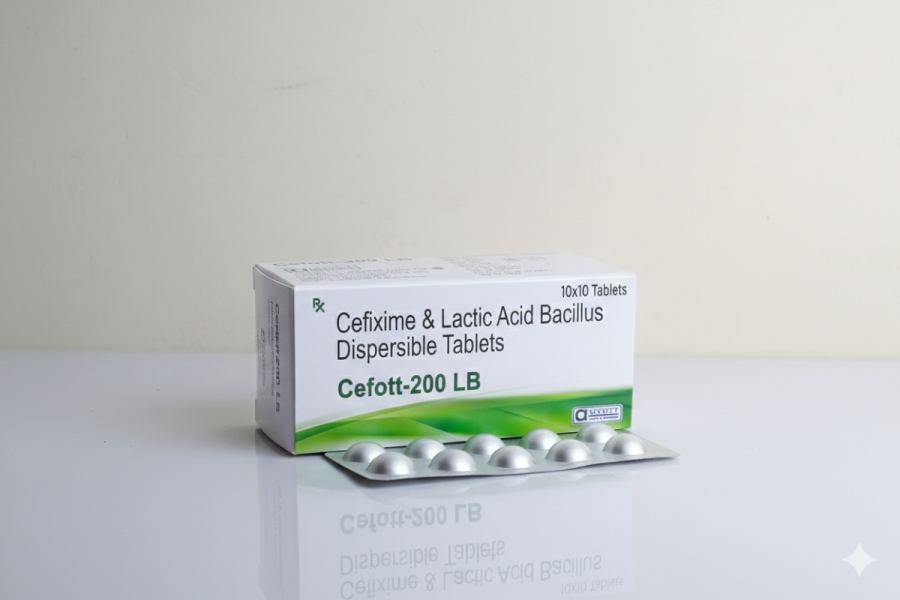
Cefott-200 LB, marketed by Accott Healthcare. The box identifies it as “Cefixime & Lactic Acid Bacillus Dispersible Tablets.”
This is an antibiotic combined with a probiotic, rather than the cefixime-only Cefott-200 you showed previously.
The formulation is generally:
A current listing for cefixime + lactic acid bacillus products gives the combination as cefixime 200 mg + lactic acid bacillus 2.5 billion spores. However, because the photograph only shows the front of the Cefott-200 LB box, I would verify the exact probiotic strength from the strip/back label before treating 2.5 billion as definitive for this particular batch. (Tradeindia)
LB generally refers to the Lactic Acid Bacillus component.
So:
Cefott-200 LB = Cefixime 200 mg + Lactic Acid Bacillus
1. Cefixime 200 mgCefixime is a third-generation cephalosporin antibiotic.
It belongs to the β-lactam family and kills susceptible bacteria by interfering with their cell-wall synthesis.
Bacteria need a rigid cell wall to survive.
Cefixime:
Cefixime → binds bacterial penicillin-binding proteins → inhibits cell-wall formation → weakens bacterial cell wall → bacterial death
It therefore works against susceptible bacterial infections, not viral infections.
Depending on the bacteria and local resistance patterns, cefixime can be used for:
Urinary-tract infections
Certain throat/tonsil infections
Certain ear infections
Some respiratory bacterial infections
Certain gastrointestinal bacterial infections
Enteric/typhoid fever in appropriate circumstances
It should not be used simply for a common cold, influenza, or another viral illness.
2. Lactic Acid BacillusThe second component is Lactic Acid Bacillus, a probiotic-type organism.
Antibiotics can disturb the normal bacterial population in the intestine. This can sometimes contribute to:
Loose stools
Diarrhea
Abdominal discomfort
Changes in normal intestinal flora
The lactic-acid-bacillus component is included to support the intestinal microbial environment during antibiotic treatment.
The probiotic does not replace the antibiotic.
It also does not mean that diarrhea cannot occur. It is intended as supportive therapy.
3. Why combine cefixime with Lactic Acid Bacillus?The basic rationale is:
Cefixime → treats susceptible bacterial infection
Lactic Acid Bacillus → supports intestinal flora during antibiotic treatment
So this formulation is particularly useful when a doctor wants cefixime therapy while also providing a probiotic component.
It is not two antibiotics.
This is an important difference from the Cefott-O you showed earlier.
4. Cefott-200 LB vs Cefott-200You have shown both products, and they are easy to confuse.
Cefixime 200 mg
One active antibiotic.
Cefixime 200 mg + Lactic Acid Bacillus
Antibiotic + probiotic.
The “LB” version does not mean a stronger antibiotic. The cefixime dose remains 200 mg; the additional component is the probiotic.
5. Cefott-200 LB vs Cefott-OThese are substantially different:
Cefott-O should not be considered equivalent to Cefott-200 LB.
Ofloxacin is an antibiotic, whereas Lactic Acid Bacillus is a probiotic.
6. How is Cefott-200 LB taken?Because this is a dispersible tablet, it is designed to disperse in water before administration. Follow the specific instructions supplied with the product.
The dose and duration depend on the patient and infection.
For cefixime, dosing can vary according to:
Age
Body weight
Infection
Severity
Kidney function
Bacterial susceptibility
Therefore, don't determine the number of tablets solely from the 200 mg printed on the box.
7. Common side effectsThe most common effects are related to cefixime and may include:
Diarrhea
Nausea
Vomiting
Abdominal discomfort
Indigestion
Headache
Dizziness
Skin rash
The probiotic component is generally intended to support gut health, but it does not eliminate the possibility of antibiotic-associated diarrhea.
8. Serious warning signsSeek medical attention if there is:
Difficulty breathing
Swelling of the face, lips or tongue
Severe allergic rash
Blistering or peeling skin
Severe or persistent diarrhea
Blood/mucus in stool
Severe abdominal pain
Severe or persistent diarrhea after an antibiotic can sometimes indicate Clostridioides difficile-associated diarrhea, which requires medical assessment.
9. Important precautionsTell the doctor if the patient has:
Previous serious allergy to cefixime/cephalosporins
Significant penicillin allergy
Kidney disease
Previous antibiotic-associated colitis
Pregnancy or breastfeeding
Multiple medications
Cefixime is substantially eliminated through the kidneys, so kidney impairment can require dose adjustment.
10. Can it be taken with food?Cefixime can generally be administered with or without food, but follow the instructions on the prescription/product leaflet.
For a dispersible tablet, follow the product's instructions for dispersing it in water rather than assuming it should be swallowed in the same way as an ordinary tablet.
You've now shown four Cefott products:
Cefott-100
→ Cefixime 100 mg
Cefott-200
→ Cefixime 200 mg
Cefott-200 LB
→ Cefixime 200 mg + Lactic Acid Bacillus
Cefott-O
→ Cefixime 200 mg + Ofloxacin 200 mg
They should not be substituted for one another based only on the name or strength.
Most importantly, Cefott-200 LB and Cefott-O are not interchangeable. Cefott-O contains a second antibiotic (ofloxacin), while Cefott-200 LB contains a probiotic.
If these different Cefott medicines are all present in the same prescription/medicine collection, don't take them together unless the prescribing doctor explicitly prescribed that combination, because you could unintentionally duplicate cefixime or take unnecessary antibiotics.