
Hover to zoom · click to enlarge
| Composition | Pantoprazole Gastro-resistant Tablets IP |
|---|---|
| Packing | 10*10ALU |
| SHELF LIFE | 24 MONTHS |
| HSN CODE | 3004 |
| Category | Tablets |
| Supply | Wholesale & Export |
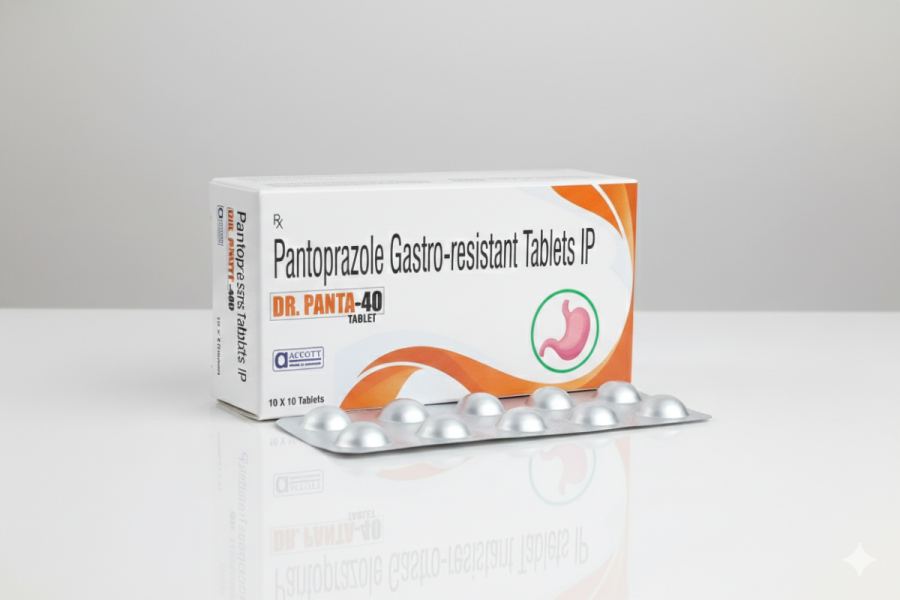
From the photograph, the medicine is DR. PANTA-40 Tablet manufactured/marketed by Accott Healthcare. The carton states “Pantoprazole Gastro-resistant Tablets IP” and 40 mg strength.
The active pharmaceutical ingredient (API) is:
Pantoprazole Sodium IP — equivalent to Pantoprazole 40 mg
In Indian formulations, this is generally expressed as:
Each gastro-resistant tablet contains:
Pantoprazole Sodium IP equivalent to Pantoprazole — 40 mg
Excipients — q.s.
This means the tablet contains an amount of pantoprazole sodium that provides 40 mg of pantoprazole active moiety. For comparison, some regulatory product specifications report approximately 45.1–45.2 mg of pantoprazole sodium sesquihydrate as equivalent to 40 mg pantoprazole. (Medicines.org.uk)
An Indian pantoprazole product specification similarly describes the composition as pantoprazole sodium IP equivalent to pantoprazole 40 mg, with excipients q.s. (Zuventus)
This is an important part of the formulation.
Pantoprazole is acid-labile, meaning it can be degraded by the acidic environment of the stomach. Therefore, the tablet is manufactured with an enteric/gastro-resistant coating.
The tablet essentially has:
Tablet core → drug + excipients → gastro-resistant/enteric coating
The coating prevents substantial release of the drug in the stomach and allows the tablet to pass into the intestine, where the coating dissolves at a higher pH and the drug can be released.
Consequently:
Do NOT crush, chew or break the gastro-resistant tablet unless the specific product information says it can be modified. Regulatory information for pantoprazole gastro-resistant tablets specifically instructs patients to swallow them whole. (Medicines.org.uk)
3. Excipients — in detailThe exact inactive-ingredient formulation of Accott's DR. PANTA-40 is not legible on the front of the package shown, and I could not find an authoritative Accott document online giving the complete excipient formula for this particular tablet.
Therefore, I would not claim that every ingredient below is definitely present in DR. PANTA-40.
However, pantoprazole 40-mg gastro-resistant tablets from different manufacturers commonly use excipients such as:
Sodium carbonate — helps maintain an alkaline microenvironment and contributes to formulation stability.
Mannitol or lactose — filler/bulking agent in some formulations.
Microcrystalline cellulose — filler and tablet-structure agent in some formulations.
Crospovidone — superdisintegrant that helps the tablet core break down after the gastro-resistant coating dissolves.
Hydroxypropyl cellulose — binder used during tablet manufacture.
Calcium stearate — lubricant.
Colloidal silica — glidant in some formulations.
Different manufacturers use different combinations. For example, one authorized 40-mg formulation lists sodium carbonate, mannitol, crospovidone, hydroxypropyl cellulose and calcium stearate, while another uses lactose, hydroxypropylcellulose, calcium stearate, sodium carbonate and other excipients. (Medicines.org.uk)
Common coating materials can include:
Hypromellose
Methacrylic acid–ethyl acrylate copolymer
Triethyl citrate
Polysorbate 80
Sodium lauryl sulfate
Iron oxide pigments
Titanium dioxide
Macrogols/propylene glycol, depending on the formulation
These materials provide the protective, gastro-resistant coating and the required physical characteristics. (Medicines.org.uk)
Important: these are examples from approved pantoprazole products, not a confirmed ingredient list for DR. PANTA-40.
4. Pharmacological composition/classPantoprazole = Proton Pump Inhibitor (PPI)
It belongs to the benzimidazole-derived proton-pump inhibitor class.
Its therapeutic action is not simply “neutralizing acid.” Instead, it suppresses the production of gastric acid.
Inside the stomach are parietal cells, which produce hydrochloric acid (HCl).
The final step of acid secretion is controlled by an enzyme called:
H⁺/K⁺-ATPase
This is commonly called the gastric proton pump.
Pantoprazole reaches the acidic secretory canaliculus of the parietal cell and is converted to its active form. It then forms an irreversible covalent bond with the H⁺/K⁺-ATPase proton pump.
Therefore:
Pantoprazole → inhibits H⁺/K⁺-ATPase → decreases HCl secretion → decreases gastric acidity
It suppresses both basal and stimulated gastric acid secretion. (Lybrate)
5. What is it used for?Pantoprazole 40 mg is used for conditions in which reducing gastric acid is therapeutically useful, including:
It reduces acid exposure to the esophagus and is used in the treatment of reflux oesophagitis/GERD.
Reducing acid allows an ulcerated gastric mucosa to heal.
Acid suppression promotes healing of ulcers in the duodenum.
Pantoprazole can be used in combination with appropriate antibiotics as part of an H. pylori eradication regimen when indicated. (Medicines.org.uk)
This is a condition involving excessive gastric acid secretion, and higher-dose acid suppression may be required under specialist supervision.
6. How it is generally takenFor a conventional 40-mg gastro-resistant tablet, it is commonly taken:
Once daily, approximately 1 hour before a meal, with water.
The exact dose and duration depend on the condition being treated. Some conditions require a different regimen or combination with other medicines. (Medicines.org.uk)
Swallow whole.
Do not:
crush it
chew it
grind it
open/alter the gastro-resistant dosage form
because doing so can interfere with the protective formulation. (Medicines.org.uk)
7. Common adverse effectsPantoprazole is generally well tolerated, but possible adverse effects include:
headache
nausea
abdominal discomfort/pain
diarrhea
constipation
flatulence
dizziness
vomiting
Not everyone experiences these effects.
With long-term PPI treatment, clinicians may also consider issues such as vitamin/mineral deficiencies, certain infections, and other complications depending on the patient's circumstances and duration of therapy.
8. Important drug interactionsBecause pantoprazole markedly suppresses gastric acid, it can alter the absorption of medicines whose absorption depends on an acidic gastric environment. Examples include certain azole antifungals and some other medicines. (Medicines.org.uk)
Particular caution is required with some HIV protease inhibitors, such as atazanavir, because reduced gastric acidity can substantially reduce their absorption. (Medicines.org.uk)
Therefore, the complete medication list should be considered before long-term or combination therapy.
Bottom line: The important active composition of the pictured DR. PANTA-40 is Pantoprazole 40 mg, formulated as a gastro-resistant tablet. The exact inactive/excipient composition cannot be reliably determined from the front of this photograph; different manufacturers use substantially different excipient systems. (Medicines.org.uk)
If you upload a clear photograph of the back of the DR. PANTA-40 box or the blister strip, I can read the exact printed composition, excipients, manufacturing details, storage, MRP, batch number and expiry from it.