
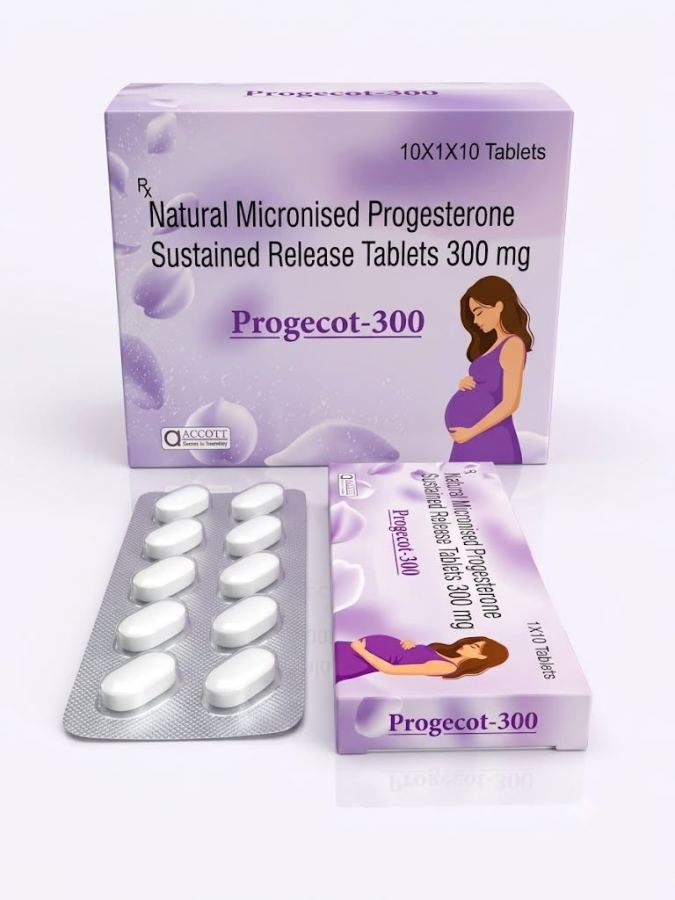
Hover to zoom · click to enlarge
| Composition | Natural Micronised Progesterone Sustained-release TABLETS |
|---|---|
| Packing | 10*1*10 BLISTER |
| SHELF LIFE | 24 MONTHS |
| HSN CODE | 3004 |
| Category | Tablets |
| Supply | Wholesale & Export |
Progecot-300 is labelled in the supplied image as a Natural Micronised Progesterone Sustained Release Tablet 300 mg.
Each sustained-release tablet contains:
IngredientQuantity per tabletRoleNatural Micronised Progesterone300 mgActive pharmaceutical ingredientPharmaceutical excipientsq.s.Tablet manufacture, stability and sustained drug releaseActive strength: 300 mg/tablet
The image does not show the complete quantitative excipient formula, so the exact quantities of individual inactive ingredients cannot be reliably determined from the packaging.
Progesterone is a naturally occurring steroidal progestogen. It is chemically identical to endogenous human progesterone.
It acts primarily through progesterone receptors, producing characteristic progestogenic effects in reproductive tissues.
Progesterone has poor aqueous solubility. Micronisation reduces the particle size, increasing the surface area available for dissolution.
This can improve:
Dissolution characteristics
Dispersion of the drug
Absorption following administration
Dose uniformity in the formulation
The product is specifically described as a sustained-release tablet.
Unlike an immediate-release tablet, the formulation is designed to release the active ingredient progressively.
A sustained-release formulation generally uses one or more mechanisms such as:
A polymer hydrates after contact with gastrointestinal fluid and forms a gel layer. Progesterone then diffuses through or is released as the matrix gradually erodes.
A water-resistant matrix slows penetration of fluid and consequently slows drug release.
Depending on the manufacturer's technology, release may also be controlled through specialized polymers or coating systems.
The particular release-control technology used in Progecot-300 cannot be established from the photograph.
4. Possible excipient categoriesA sustained-release progesterone tablet normally requires several functional excipient categories.
Provides adequate bulk and helps achieve the required tablet weight.
Examples can include:
Microcrystalline cellulose
Lactose
Dibasic calcium phosphate
Helps powder particles adhere during granulation/compression and provides mechanical strength.
Examples can include:
Povidone
Hydroxypropyl cellulose
Other pharmaceutical binders
This is particularly important for a sustained-release formulation.
Potential examples include:
Hydroxypropyl methylcellulose (HPMC)
Other cellulose derivatives
Hydrophobic matrix-forming polymers
The actual polymer and its concentration must be confirmed from the manufacturer's formulation.
Depending on the formulation, a disintegrant may be incorporated to control the physical breakup of portions of the tablet.
Examples include:
Crospovidone
Sodium starch glycolate
Croscarmellose sodium
For a sustained-release product, the amount and type of disintegrant must be carefully selected because excessive disintegration can alter the intended release profile.
Improves powder flow during manufacturing.
A commonly used example is:
Colloidal silicon dioxide
Reduces friction between the formulation and tablet tooling.
A commonly used example is:
Magnesium stearate
If the tablets are film-coated, coating components can include:
Film-forming polymer
Plasticizer
Opacifier
Colouring material
The above are examples of pharmaceutical excipients, not a confirmed ingredient list for Progecot-300.
5. Strength calculationEach tablet contains:
Natural micronised progesterone = 300 mg
Therefore:
1 tablet = 300 mg progesterone
10 tablets = 3,000 mg = 3 g
100 tablets = 30,000 mg = 30 g
The pack shown states 10 × 1 × 10 tablets, which corresponds to 100 tablets if all stated units are included.
The calculation above represents the total active progesterone, not the total weight of the tablets.
6. Pharmaceutical classificationParameterDetailsBrandProgecot-300Active ingredientNatural Micronised ProgesteroneStrength300 mgDosage formSustained-release tabletRouteOral, unless otherwise specified by the approved product informationPharmacological classProgestogenRelease typeSustained releasePack shown10 × 1 × 10 tabletsManufacturer shownAccott7. Professional composition statementFor a PCD/product catalogue, the composition can be written as:
COMPOSITION:
Each sustained-release tablet contains:
Natural Micronised Progesterone 300 mg
Excipients q.s.
Dosage form: Sustained-release tablets.
Each sustained-release tablet contains Natural Micronised Progesterone 300 mg in a suitable pharmaceutical matrix containing appropriate release-controlling excipients, with other pharmaceutical excipients q.s.
There are three different levels of “composition”:
Label composition: what is confirmed on the pack — Natural Micronised Progesterone 300 mg.
Qualitative excipient composition: exact inactive ingredients used by the manufacturer.
Quantitative manufacturing formula: exact mg of every excipient per tablet.
The supplied image establishes Level 1, but not Levels 2 or 3. Therefore, ingredients such as HPMC, lactose, MCC, PVP or magnesium stearate should not be claimed as definitely present unless they are verified from the manufacturer's approved product specification/package insert.