
Hover to zoom · click to enlarge
| Composition | Bilastine Tablets 20 mg. |
|---|---|
| Packing | 10*10ALU |
| SHELF LIFE | 24 MONTHS |
| HSN CODE | 3004 |
| Category | Tablets |
| Supply | Wholesale & Export |
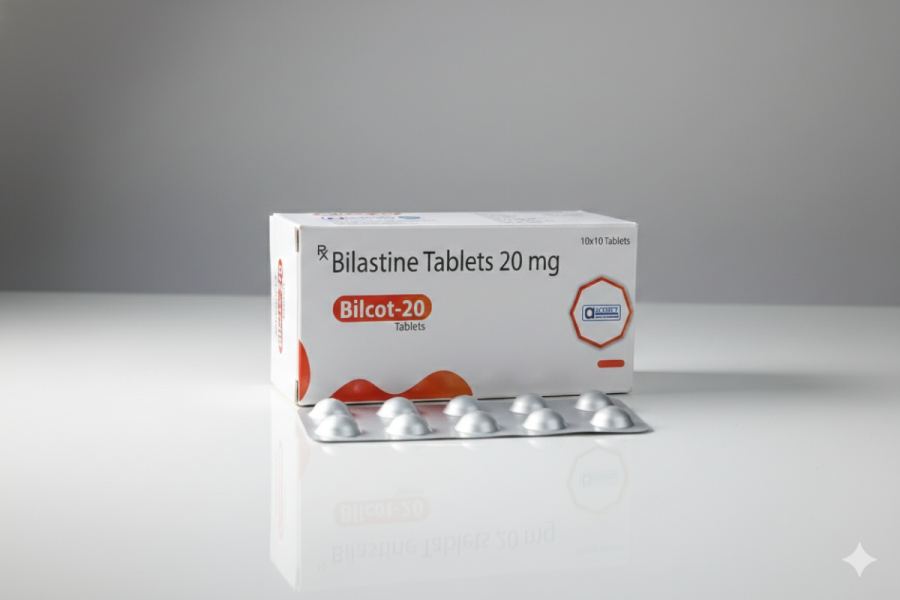
Bilcot-20 Tablets, manufactured/marketed by Accott Healthcare. The box clearly states:
Bilastine Tablets 20 mg
So, unlike Bilcot-M, this product contains only bilastine. It does not contain montelukast.
The pack shown is marked 10 × 10 tablets, i.e. 100 tablets in the full box.
1. What is bilastine?Bilastine is a second-generation H1 antihistamine used to control allergic symptoms.
When the body encounters an allergen—such as pollen, dust mites, animal dander or other triggers—it can release histamine.
Histamine binds to H1 receptors and produces symptoms such as:
Sneezing
Runny nose
Nasal itching
Eye itching
Watery eyes
Skin itching
Hives/urticaria
Bilastine blocks the H1 histamine receptor, reducing these symptoms.
Allergen → histamine release → allergy symptoms
Bilastine → blocks H1 receptors → reduces allergy symptoms
2. What is Bilcot-20 used for?Bilastine 20 mg is primarily used for:
It can relieve:
🤧 Sneezing
👃 Runny nose
👃 Nasal itching
👃 Nasal irritation
👁️ Watery eyes
👁️ Itchy eyes
This can include both:
Seasonal allergic rhinitis — for example, pollen-related allergy
Perennial allergic rhinitis — allergy occurring throughout the year
Bilastine can also reduce symptoms of urticaria, including:
Raised itchy welts
Skin itching
Redness associated with hives
No.
Bilastine is not a steroid.
It is an antihistamine.
It is also not an antibiotic and does not kill bacteria.
4. Is it a painkiller?No.
Bilcot-20 doesn't directly work as a painkiller like paracetamol or aceclofenac.
Its purpose is to control allergic symptoms.
For example:
Bilcot-20 → allergy
Chymocott → pain/inflammation
Cefott products → bacterial infection
5. How quickly does it work?Bilastine is relatively rapid-acting.
After taking a dose, antihistamine activity generally begins within about 1–2 hours, although the exact experience varies between individuals.
It is intended to provide symptom control for approximately 24 hours, which is why the usual adult regimen is once daily.
6. Usual doseFor adults and adolescents 12 years and older, the usual bilastine dose is:
20 mg once daily
So one Bilcot-20 tablet corresponds to the usual adult daily strength.
However, the actual prescription should be followed, particularly for children or people with other medical conditions.
Do not take two tablets simply because your symptoms are severe unless your doctor specifically tells you to.
7. Very important: food interactionThis is one of the most important instructions for bilastine.
Food can significantly reduce the amount of bilastine absorbed.
Therefore, bilastine 20 mg is generally taken:
or
The same precaution applies to fruit juice.
Fruit juices—including grapefruit, orange and apple juice—can reduce bilastine absorption.
If you take Bilcot-20 at 7:00 AM:
7:00 AM → Bilcot-20
8:00 AM → breakfast
Alternatively, if you have eaten breakfast at 7:00 AM, wait approximately 2 hours before taking it.
Water is the preferred drink for taking the tablet.
8. Side effectsBilastine is generally considered a relatively non-sedating antihistamine, but side effects can still occur.
Possible effects include:
Headache
Drowsiness
Dizziness
Fatigue
Nausea
Abdominal discomfort
Not everyone experiences these effects.
Compared with older antihistamines such as diphenhydramine or chlorpheniramine, bilastine generally has less sedative potential.
However, some people can still become sleepy or dizzy.
When taking it for the first time, see how it affects you before driving or operating machinery.
9. Allergic reaction to bilastineAlthough uncommon, a medicine itself can cause an allergic reaction.
Seek urgent medical attention if you develop:
Difficulty breathing
Swelling of lips/tongue/throat
Severe rash
Fainting
Rapidly worsening allergic symptoms
You previously showed Bilcot-M, so this distinction is important.
Bilastine 20 mg
→ Antihistamine only
Bilastine + Montelukast
→ Antihistamine + leukotriene receptor antagonist
Therefore:
Bilcot-20 is NOT the same as Bilcot-M.
If your doctor prescribed Bilcot-M, don't replace it with Bilcot-20 without checking whether montelukast is still required.
11. Why might a doctor choose Bilcot-20 instead of Bilcot-M?For straightforward allergic rhinitis or urticaria, an antihistamine such as bilastine may be sufficient.
Montelukast is a separate medicine that acts on leukotrienes and has additional safety considerations, including neuropsychiatric adverse effects.
Therefore, a doctor may choose bilastine alone when an antihistamine is sufficient.
12. Bilcot-20 compared with common antihistaminesBilastine belongs to the newer generation of antihistamines.
Compared with older antihistamines, it generally has:
Longer duration of action
Less sedation
Less impairment of alertness for many patients
Once-daily dosing
However, less sedating does not mean completely non-sedating.
13. Important interactionsTell your doctor/pharmacist about your other medicines.
One particularly important consideration is ketoconazole and certain other medicines that can affect bilastine concentrations.
Also, as mentioned above, food and fruit juice can substantially reduce bilastine absorption.
If you take several prescription medicines, a pharmacist can check the complete combination.
14. Kidney problemsPeople with significant kidney impairment should tell their doctor before using bilastine, particularly if they are also taking medicines that inhibit certain drug-transport systems.
The prescriber can determine whether bilastine is appropriate and whether any adjustment or alternative is necessary.
15. Pregnancy and breastfeedingIf pregnant, planning pregnancy or breastfeeding, discuss the medicine with your doctor before taking it.
The fact that a medicine is an antihistamine does not automatically mean that it is appropriate for everyone during pregnancy or breastfeeding.
Comparison with the medicines you've shownBilcot-20 = Bilastine 20 mg, a once-daily second-generation antihistamine used mainly for allergic rhinitis and urticaria. It is not an antibiotic, steroid or painkiller.
The most important practical instruction is to take bilastine away from food and fruit juice—generally 1 hour before or 2 hours after—because food can reduce its absorption.