
Hover to zoom · click to enlarge
| Composition | Cefixime Dispersible Tablets 100 mg. |
|---|---|
| Packing | 10*10ALU |
| SHELF LIFE | 24 MONTHS |
| HSN CODE | 3004 |
| Category | Tablets |
| Supply | Wholesale & Export |
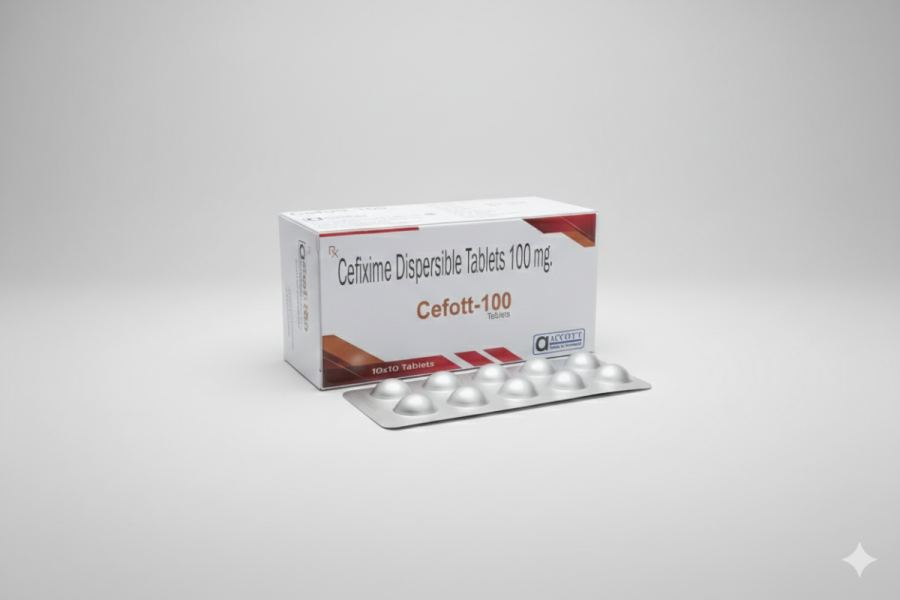
Cefott-100 Tablets, manufactured/marketed by Accott Healthcare. The front of the pack states “Cefixime Dispersible Tablets 100 mg”, so this is a cefixime 100 mg antibiotic. Accott's product listing confirms cefixime 100 mg as the active ingredient and describes it as a prescription antibiotic for susceptible bacterial infections. (Tradeindia)
Cefixime 100-mg dispersible tablets are conventionally formulated as cefixime trihydrate equivalent to 100 mg of anhydrous cefixime, with excipients added as required. (Lupin)
The box shown is marked 10 × 10 tablets, meaning 100 tablets in the complete box.
1. What is Cefixime?Cefixime is a third-generation cephalosporin antibiotic belonging to the β-lactam family.
It is a bactericidal antibiotic, meaning that against susceptible bacteria it can kill the bacteria rather than merely stopping their growth.
Bacteria need a strong cell wall to survive.
Cefixime:
binds to bacterial penicillin-binding proteins → inhibits cell-wall synthesis → weakens the bacterial cell wall → bacterial cell death
Human cells don't have this bacterial cell-wall structure, allowing cefixime to selectively act against bacteria.
2. What infections can Cefott-100 treat?Cefixime can be prescribed for susceptible bacterial infections, depending on the bacteria involved and local resistance patterns.
Examples include:
Urinary-tract infections (UTIs)
Certain throat/tonsil infections
Certain ear infections
Some respiratory-tract infections
Some gastrointestinal bacterial infections
Enteric/typhoid fever in appropriate circumstances
Accott's listing specifically identifies respiratory-tract infections, urinary-tract infections, typhoid and other susceptible bacterial infections. (Tradeindia)
A cefixime product monograph similarly lists urinary, respiratory and certain other susceptible infections, including enteric fever. (Lupin)
Cefixime does NOT treat viruses.
Therefore, it will not cure illnesses such as:
Common cold
Influenza/flu
Most uncomplicated viral sore throats
Most viral fevers
Taking an antibiotic when there is no bacterial infection exposes you to adverse effects without providing benefit and contributes to antibiotic resistance.
3. What does “dispersible” mean?The box says:
Cefixime Dispersible Tablets 100 mg
A dispersible tablet (DT) is designed to break up/disperse in water before administration.
Follow the instructions supplied with the particular product regarding how much water to use and how to administer it. Don't assume that every dispersible tablet should simply be swallowed whole.
This formulation can be particularly useful for people, including children, who have difficulty swallowing conventional tablets.
4. Why is 100 mg used?Cefixime is available in several strengths, including 100 mg and 200 mg formulations.
The appropriate dose depends on factors such as:
Age
Body weight
Type and severity of infection
Kidney function
The organism causing the infection
Other medicines being taken
For example, official product information for cefixime 100-mg dispersible tablets gives an adult/adolescent dosing range of 200–400 mg/day depending on the infection, but the actual dose and duration should be prescribed for the particular patient. (Lupin)
Do not use the 100-mg strength to determine your own dose.
5. Side effectsCefixime can cause:
Diarrhea
Nausea
Abdominal discomfort
Indigestion
Vomiting
Headache
Dizziness
Skin rash
Diarrhea is one of the more common antibiotic-related effects.
Difficulty breathing
Swelling of lips, tongue or face
Severe or rapidly spreading rash
Blistering or peeling skin
Severe/persistent diarrhea
Blood or mucus in stool
Severe abdominal pain
These can indicate a serious allergic reaction or significant antibiotic-associated intestinal inflammation.
6. Allergy precautionsCefixime belongs to the cephalosporin group.
Tell your doctor if you have previously experienced a serious allergy to:
Cefixime
Other cephalosporins
Penicillins
Other β-lactam antibiotics
A previous severe immediate allergic reaction is particularly important.
7. Kidney diseaseCefixime is eliminated substantially through the kidneys.
If someone has reduced kidney function, the doctor may need to adjust the dose or dosing interval.
This is particularly important if the medicine is being given to an elderly person or someone with known kidney disease.
8. Cefott-100 vs Cefott-200You have now shown both products.
Cefixime 100 mg
Cefixime 200 mg
Both contain the same antibiotic—cefixime; the principal difference is the strength.
The Accott listing identifies Cefott-200 as cefixime 200 mg. (Tradeindia)
Do not take Cefott-100 and Cefott-200 together unless specifically instructed, because that would simply increase the total cefixime dose.
9. Cefott-100 vs Cefott-OThis distinction is particularly important because you showed Cefott-O earlier.
Accott's Cefott-O listing confirms the cefixime 200 mg + ofloxacin 200 mg combination. (Tradeindia)
So Cefott-O is not simply a stronger version of Cefott-100. It contains a second antibiotic (ofloxacin).
Do not combine Cefott-100, Cefott-200 and Cefott-O on your own.
10. Food and administrationAccott's product information instructs patients to take the medicine as directed by the physician, with its Cefott-100 listing specifying administration after meals. (Tradeindia)
For your particular prescription, follow the doctor's instructions and the directions printed on the strip/leaflet.
If this was prescribed as an antibiotic course, take it at the prescribed intervals and don't stop or extend the course on your own.
11. Important interactionsTell your doctor/pharmacist about all medicines you take.
One particularly important interaction is with warfarin and other anticoagulants, because cefixime/cephalosporins can affect coagulation measurements in some patients.
Also inform the doctor if you are taking multiple prescription medicines, supplements or antacids.
You have shown three different products:
1. Chymocott
Trypsin + Chymotrypsin + Aceclofenac + Paracetamol
→ Pain/inflammation/swelling
2. Cefott-O
Cefixime 200 mg + Ofloxacin 200 mg
→ Antibiotic combination
3. Cefott-200 / Cefott-100
Cefixime 200 mg / 100 mg respectively
→ Cefixime antibiotic
The important point is that Cefott-100 and Cefott-200 are different strengths of the same antibiotic, whereas Cefott-O contains cefixime plus an additional antibiotic.
If these medicines were prescribed to the same person, don't substitute one for another or take all of them together without checking the prescription—particularly because Cefott-O already contains cefixime.
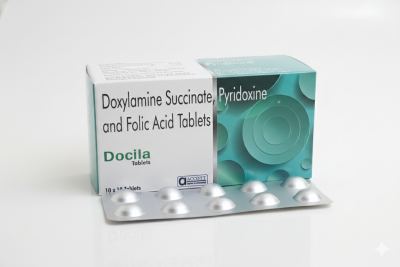
Doxylamine Succinate — ____ mg Pyridoxine Hydrochloride (Vitamin B6) — ____ mg Folic Acid — ____ mg
10*10ALU