Tablets
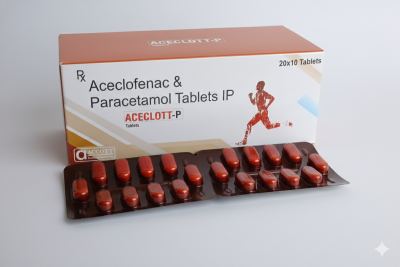
ACECLOTT-P TAB( AMBER PVC)
Aceclofenac & Paracetamol Suspension IP
20*10 (BLISTER) AMBER PVC
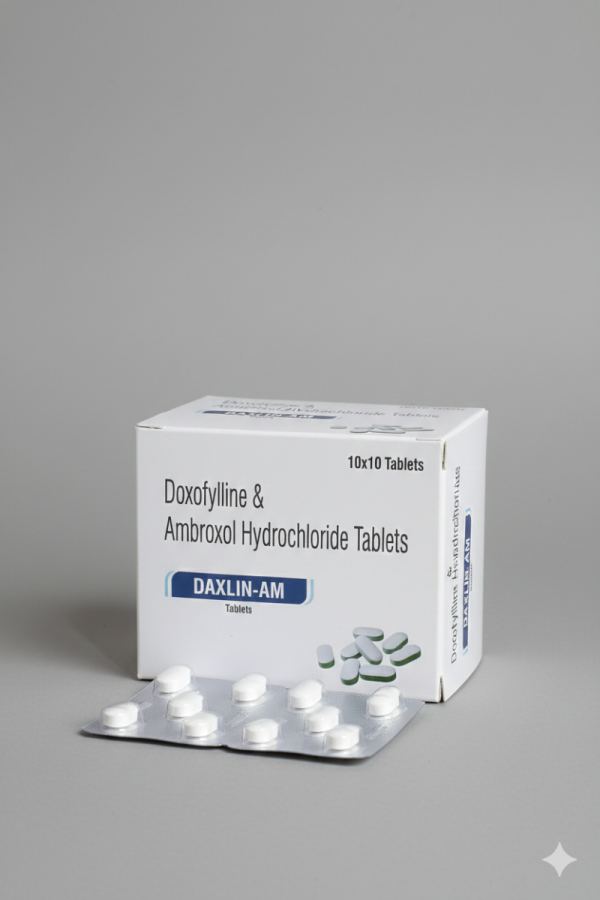
Hover to zoom · click to enlarge
| Composition | Doxofylline & Ambroxol Hydrochloride Tablets. |
|---|---|
| Packing | 10*10 BLISTER |
| SHELF LIFE | 24 MONTHS |
| HSN CODE | 3004 |
| Category | Tablets |
| Supply | Wholesale & Export |
The photograph shows DAXLIN-AM Tablets. The carton states:
Doxofylline & Ambroxol Hydrochloride Tablets
So this is a two-drug respiratory medicine, generally used when airway narrowing/bronchospasm is accompanied by thick mucus or difficulty clearing phlegm.
The commonly marketed Doxofylline + Ambroxol tablet formulation is:
Important: the front of your photograph does not show the numerical strengths, so 400 mg + 30 mg should be confirmed against the blister/back panel of your particular DAXLIN-AM pack before use. I could not find a reliable online Accott source confirming this exact brand's strengths.
1. Doxofylline — 400 mgBronchodilator / xanthine derivative
Doxofylline is related pharmacologically to the methylxanthine group and is used to help relieve bronchial obstruction.
It promotes relaxation of bronchial smooth muscle, resulting in:
Bronchial smooth muscle relaxation → wider airways → improved airflow → easier breathing
It is therefore used in conditions involving bronchospasm or airway obstruction, such as some patients with:
bronchial asthma
chronic obstructive pulmonary disease (COPD)
bronchospasm associated with other respiratory disorders
Doxofylline is not an antibiotic and does not eliminate a respiratory infection.
It also isn't the same as an inhaled rescue bronchodilator such as salbutamol. The onset and clinical role are different.
2. Ambroxol Hydrochloride — 30 mgMucolytic / secretolytic agent
Ambroxol is used when respiratory secretions are thick and difficult to clear.
It helps reduce the viscosity of bronchial mucus and promotes mucus clearance.
Simplified:
Thick mucus → Ambroxol → less viscous mucus + improved mucociliary clearance → easier expectoration
This can make productive coughing more effective.
Ambroxol also has effects on pulmonary surfactant and mucociliary transport.
3. Why combine Doxofylline and Ambroxol?The two ingredients address different aspects of respiratory symptoms:
Opens/relaxes the airways
Helps loosen and clear mucus
Together:
                  DAXLIN-AM
                      │
          ┌───────────┴───────────┐
          │                       │
     DOXOFYLLINE               AMBROXOL
          │                       │
          ↓                       ↓
   Bronchodilation          Mucus thinning/
          │                  clearance
          ↓                       ↓
   Improved airflow        Easier sputum
          │                       │
          └───────────┬───────────┘
                      ↓
              Easier breathing
              + mucus clearance
This makes the combination particularly logical when a patient has airway narrowing together with troublesome mucus.
4. What is it generally used for?Depending on the patient's diagnosis, this type of combination may be prescribed for respiratory conditions involving:
bronchospasm
wheezing
productive cough with thick mucus
asthma with mucus production
COPD with obstructive symptoms and sputum
It should be used according to the diagnosis rather than simply for any cough.
5. Doxofylline — important adverse effectsPossible effects include:
nausea
vomiting
stomach discomfort
headache
dizziness
palpitations
tremor
insomnia
increased heart rate
Xanthine-related drugs can produce cardiovascular and central-nervous-system effects, particularly at excessive concentrations.
Patients with significant heart disease, arrhythmias, hypertension, liver disease or other relevant conditions should inform their doctor.
6. Ambroxol — possible adverse effectsPossible effects include:
nausea
vomiting
abdominal discomfort
diarrhea
dry mouth
altered taste
Rarely, serious allergic or severe skin reactions can occur. A new widespread rash, blistering, swelling of the face/lips, or difficulty breathing requires urgent medical assessment.
7. Important drug-interaction considerationsThe medication list should be reviewed if the patient is taking:
other bronchodilators
medicines affecting heart rhythm
stimulant medicines
multiple respiratory medicines
medicines that cause significant gastrointestinal effects
Doxofylline has a different interaction profile from theophylline, but it is still important not to assume that combining multiple xanthine/bronchodilator products is harmless.
8. Is DAXLIN-AM an antibiotic?No.
Neither ingredient is an antibiotic.
It does not directly kill bacteria.
If cough is caused by a bacterial infection, treatment depends on the actual diagnosis; an antibiotic should not be added automatically.
9. Is it a steroid?No.
DAXLIN-AM does not contain a corticosteroid such as:
prednisolone
deflazacort
dexamethasone
budesonide
This is important because DAXLIN-AM and DEFZACOTT-6, which you showed previously, are pharmacologically very different medicines.
10. Is it a cough suppressant?Not primarily.
Ambroxol is a mucolytic, meaning it is intended to make mucus easier to clear.
Therefore, if the patient has a productive/phlegmy cough, suppressing the cough reflex indiscriminately may not always be desirable because coughing helps remove loosened secretions.
11. ExcipientsIn addition to the two active ingredients, the tablet contains excipients q.s.
These are used for:
tablet formation
binding
disintegration
lubrication
stability
appearance
The photograph does not show a sufficiently clear composition panel to identify the individual excipients and their quantities, so I would not guess them.
Doxofylline — commonly 400 mg
Ambroxol Hydrochloride — commonly 30 mg
Excipients — q.s.
Doxofylline → bronchodilation → improved airflow
Ambroxol → mucolysis + improved mucus clearance → easier expectoration
Bronchial obstruction/wheezing + thick respiratory secretions
Important: Since the exact strength is not readable on the front of this particular box, please upload a clear photograph of the back/side of the DAXLIN-AM box or the blister foil if you want me to verify the exact mg composition and list every excipient.
Aceclofenac & Paracetamol Suspension IP
20*10 (BLISTER) AMBER PVC