
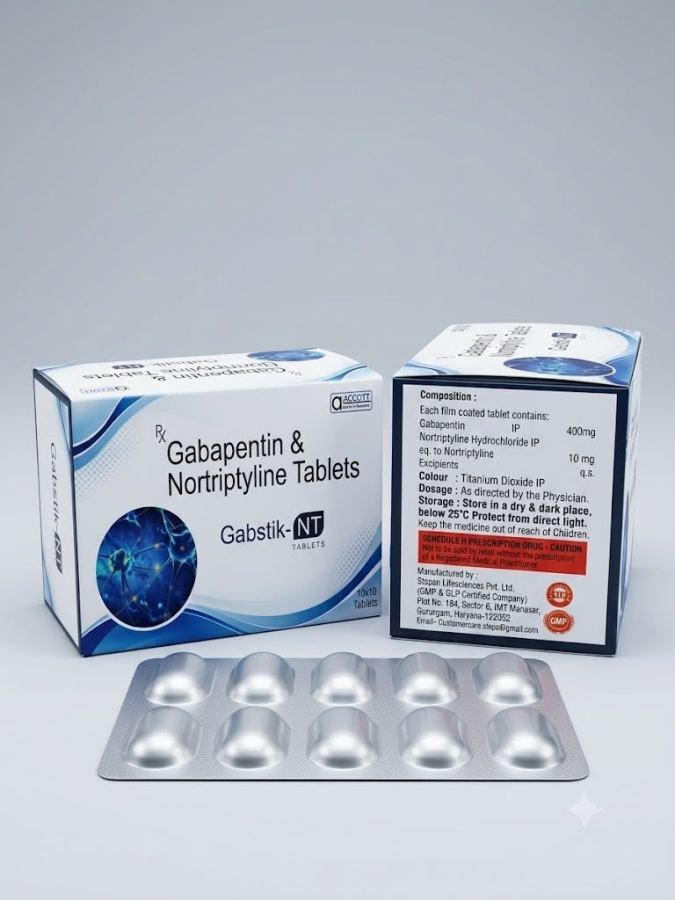
Hover to zoom · click to enlarge
| Composition | Gabapentin & Nortriptyline TABLETS |
|---|---|
| Packing | 10*10ALU |
| SHELF LIFE | 24 MONTHS |
| HSN CODE | 3004 |
| Category | Tablets |
| Supply | Wholesale & Export |
Gabapentin is the first active pharmaceutical ingredient (API).
Strength: 400 mg per film-coated tablet
Pharmacological class: Gabapentinoid
Main action: It reduces abnormal nerve signalling and decreases excessive neuronal excitability.
Common therapeutic use: Particularly neuropathic (nerve) pain; it is also used for certain seizure disorders.
IP: “IP” means the ingredient complies with the applicable Indian Pharmacopoeia standard.
Gabapentin is not an opioid and does not work primarily through opioid receptors.
The second active ingredient is Nortriptyline Hydrochloride.
The label specifically states:
Nortriptyline Hydrochloride IP equivalent to Nortriptyline — 10 mg
This distinction is important.
Active therapeutic equivalent: Nortriptyline 10 mg
Form used in the tablet: Nortriptyline hydrochloride salt
Pharmacological class: Tricyclic antidepressant (TCA)
Use in this combination: Particularly useful in the management of neuropathic pain and related pain syndromes.
Nortriptyline can influence neurotransmitters such as norepinephrine and serotonin, which can modify the way the nervous system processes pain.
What does “equivalent to 10 mg” mean?Nortriptyline hydrochloride is the salt form of nortriptyline. Because the hydrochloride salt has a different molecular weight from nortriptyline itself, the manufacturer expresses the strength as the amount equivalent to 10 mg of nortriptyline.
Theoretically, using molecular weights, 10 mg nortriptyline base corresponds to approximately 11.4 mg of nortriptyline hydrochloride. The actual manufacturing specification is controlled according to the applicable pharmaceutical standard and assay requirements.
The package states:
Excipients — q.s.
q.s. means quantum satis, or quantity sufficient.
These are inactive ingredients that are required to manufacture the tablet. They can serve functions such as:
Giving the tablet adequate size and weight
Providing binding during tablet compression
Helping the tablet disintegrate appropriately
Improving manufacturing properties
Providing stability
Helping the film coating adhere to the tablet
Improving appearance and handling
The exact names and quantities of all excipients cannot be determined from the visible composition panel. “q.s.” does not mean there is a fixed unspecified amount; it means the manufacturer uses the quantity necessary according to its formulation.
The pack specifies:
Colour: Titanium Dioxide IP
Titanium dioxide is used primarily as a white pigment/opacifying agent in pharmaceutical coatings.
Its purpose can include:
Giving the tablet a uniform white appearance
Making the film coating opaque
Improving the visual appearance of the dosage form
Helping provide a consistent coating
It is not an active pain-relieving ingredient.
So, the clinically relevant active ingredients in one Gabstik-NT tablet are:
ComponentAmount per tabletTypeGabapentin IP400 mgActive ingredientNortriptyline Hydrochloride IPEquivalent to Nortriptyline 10 mgActive ingredientExcipientsq.s.Inactive ingredientsTitanium Dioxide IPAs requiredColour/opacifierEach film-coated Gabstik-NT tablet contains Gabapentin IP 400 mg + Nortriptyline Hydrochloride IP equivalent to Nortriptyline 10 mg + Excipients q.s., with Titanium Dioxide IP as colour.
The combination is designed to provide two complementary mechanisms for controlling neuropathic pain:
Gabapentin → reduces abnormal nerve excitability/signalling
Nortriptyline → modifies central pain processing through monoamine neurotransmitter pathways
This is why this type of combination is generally used for nerve-related pain, rather than ordinary short-term pain such as a simple headache.
If you want, I can also give you a very detailed explanation of each ingredient, mechanism of action, uses, dose, side effects, contraindications, drug interactions, and precautions of Gabstik-NT 400/10 mg.